How to Capture the Rarest and Most Valuable Insects with Shin Chan
In Shin Chan: Me and the Professor on Summer Vacation, catching rare bugs goes beyond the personal satisfaction of completing your encyclopedia.

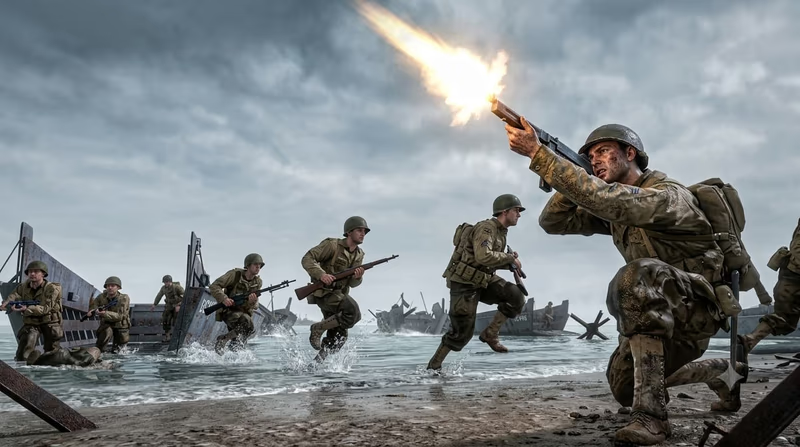
Image captured on Xbox Series X and retouched with Nano Banana.

In late 2005, the gaming world was on the brink of a new hardware generation. Infinity Ward took the groundwork from their acclaimed debut and built something that would permanently alter the course of first-person shooters: Call of Duty 2.
Serving as a flagship showcase for the original Xbox 360 and PC platforms, it dethroned Medal of Honor as the definitive World War II simulator.
It was not just a sequel; it was the exact moment the franchise established itself as an unstoppable titan in the industry.
Call of Duty 2 introduced a mechanical shift that redefined action games for the next two decades: regenerating health.
By ditching traditional health packs in favor of taking cover when the screen turned red, Infinity Ward completely altered the pacing of the gunplay. Players were forced to push aggressively, take calculated risks, and recover under pressure rather than hoard medical supplies.
The game also pioneered the tactical use of volumetric smoke grenades. Smoke was not just a fancy visual effect; it was an essential gameplay mechanic required to blind MG42 machine gun nests and cross open, deadly kill zones safely.
The single-player campaign split its narrative across three distinct Allied perspectives, keeping the pacing relentless and varied:
From an audiovisual standpoint, Call of Duty 2 was years ahead of its time.
The sound design created an unparalleled sense of immersion. Soldiers screamed orders over deafening artillery strikes, weapon fires echoed off ruined brick walls, and the crack of enemy sniper rounds kept players pinned behind cover.
Technically, the game pushed impressive particle effects, dynamic lighting, and dense smoke clouds while maintaining a rock-solid frame rate. The rifles felt weighty, the hitboxes were exceptionally precise, and responsive controls ensured zero noticeable input lag during chaotic firefights.
Long before custom loadouts and game-changing killstreaks dominated the franchise, Call of Duty 2 delivered pure, skill-based online multiplayer.
Legendary maps like Toujane, Burgundy, and Carentan became the breeding ground for competitive FPS play. Combat relied heavily on map awareness, quick reflexes, and raw bolt-action rifle precision (such as mastering the Kar98k or the M1 Garand).
It was fast, brutal, and completely unbloated by modern progression systems.
Pros:
Cons:
Call of Duty 2 is an undisputed masterpiece that holds up remarkably well today. It did not just raise the bar for World War II shooters—it established the blueprint for modern action games.
If you want to experience the exact moment the FPS genre transformed into a cinematic blockbuster powerhouse, this classic remains an absolute must-play.

Affiliate link: Support the blog via Instant Gaming at no extra cost.
Call of Duty 2
Others Posts
In Shin Chan: Me and the Professor on Summer Vacation, catching rare bugs goes beyond the personal satisfaction of completing your encyclopedia.
Stepping onto the war-torn surface of Stroggos is a death sentence if you come unprepared. In Quake 4, health and ammunition deplete incredibly fast, and the cybernetic alien forces will overwhelm you if you rely on brute force alone.
Project Aces makes a triumphant return to Strangereal with Ace Combat 7: Skies Unknown, combining revolutionary volumetric cloud warfare, blistering high-G dogfights, and Keiki Kobayashi's soaring orchestral score.

Black Lab Games brought Warhammer 40k's tabletop wargame to life with grid-based tactics, blood-soaked executions, and the aggressive Momentum system.
Coordinates, Spawns, and Secrets in Shin Chan's Summer Vacation. These top-tier specimens are the most elusive creatures in the game. Catching them is not just a badge of honor for completionists, it is the ultimate key to securing the most

SEGA and Toshihiro Nagoshi created a masterpiece of robot destruction. Here is our full retrospective on Binary Domain's lore, mechanics, and cult status.

Are the Minecraft Dungeons DLCs worth buying? We break down all 6 expansions, their biomes, unique mechanics, boss fights, and rank the absolute must-haves.
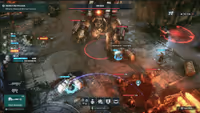
Master turn-based combat in Gears Tactics. Learn to chain executions for infinite Action Points, optimize class builds, and crush colossal bosses.

Analysis of the PlayStation 4 and PS4 Pro hardware. We examine the shared CPU bottleneck, the mirrored butterfly GPU design, memory optimizations, and the hardware-level checkerboard rendering that enabled the 4K transition.

PlayStation 5 Pro hardware: PSSR, Advanced Ray Tracing, and the AI Revolution. We analyze Sony's PlayStation Spectral Super Resolution (PSSR), RDNA 4 Ray Tracing advancements, and the engineering behind the end of the Fidelity vs. Performance compromise.
guides
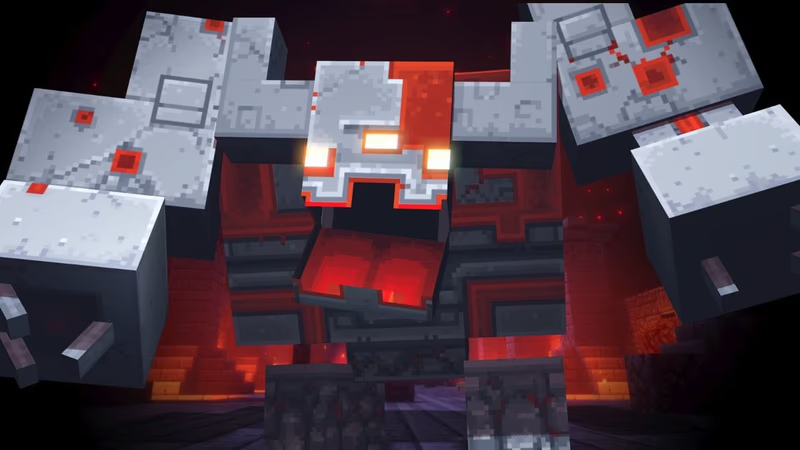
Conquer the toughest bosses in Minecraft Dungeons. Master attack patterns, exploit weak points, and equip the best builds for every major fight.