Wasteland 2 Companion & Recruitment Guide: Best Recruits, Builds & Progression
Build the ultimate Wasteland 2 squad. We rank the best recruits in Arizona and LA, explain stats evolution, and list the most essential skills for smooth progression.
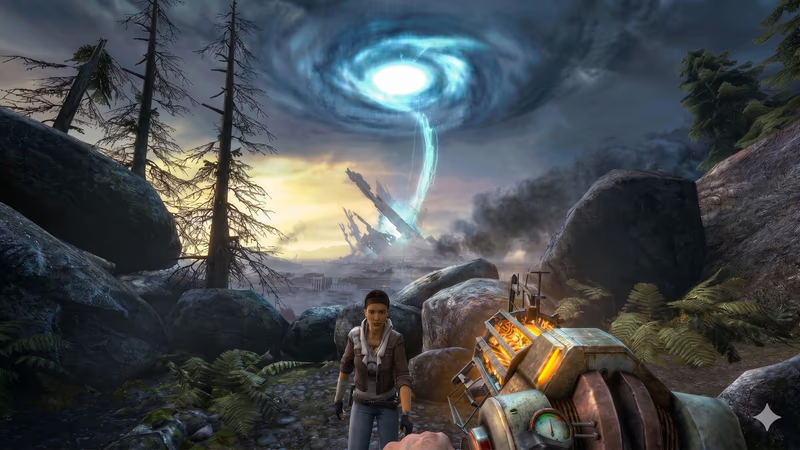
Image captured on Xbox Series X and retouched with Nano Banana.

Two decades after their release, the episodic additions to Half-Life 2 stand as some of Valve's finest work, showcasing brilliant cooperative AI and stunning environmental design—yet they remain forever haunted by a single, agonizing cliffhanger.
When Half-Life 2 arrived in 2004, it redefined what was possible in linear, narrative-driven first-person shooters. But the story was far from over. Rather than diving immediately into another five-year development cycle for a Half-Life 3, Valve embarked on an audacious, controversial strategy: episodic content. The goal was to release smaller, high-quality continuations more frequently, keeping the story alive. The result was two episodes that, while short, offered perhaps the most refined and satisfying design of the entire trilogy.
The story begins exactly where Half-Life 2 left off: at the very apex of the City 17 Citadel, caught in the slow-motion moment of its explosion. After being rescued by Vortigaunts, Gordon Freeman is reunited with Alyx Vance, and together they must navigate the collapsing, burning ruins of the city that once oppressed them. This journey turns Alyx into the true co-protagonist of the experience, and her dynamic relationship with Gordon forms the emotional backbone of both episodes.
Half-Life 2: Episode One (2006) is an exercise in intense, close-quarters focus. It is significantly shorter than its predecessor, but Valve uses this brevity to tighten the relationship between Gordon and Alyx. The design philosophy of Episode One revolves entirely around cooperation. Alyx is not just an essential companion; she is a powerful ally with incredible aim, and her EMP tool is vital for puzzles and shutting down Combine energy shields.
The atmosphere is claustrophobic and tense. The gameplay is an unrelenting escape across a singular landscape—initially deep inside the core of the unstable Citadel, then through the dark, zombie-infested underground (using only your flashlight for illumination), and finally through the war-torn city streets towards the last evacuation train. This tight design successfully reinforces the player’s dependence on Alyx, making every quiet moment they share feel valuable and every chaotic battle feel genuinely shared.
If Episode One was a refined urban epilogue, Half-Life 2: Episode Two (2007) is a spectacular evolution. Valve used the extra development time to push the Source engine significantly, introducing improved lighting, cinematic visual effects, and a move toward much wider, natural environments. Leaving the grey concrete of City 17 behind, you traverse the rugged, scenic landscapes surrounding White Forest.
This expansion of scale allows for some of the best pacing in the entire series. Vehicle combat returns, and the drive through the scenic but dangerous countryside is a blast, culminating in satisfying encounters with Combine Hunter-Choppers and Strider attacks. The new Hunter enemies are also a triumph of AI design, forcing players to prioritize targets and utilize aggressive flanking tactics. Episode Two is simply Valve at the top of its game, delivering a seamless blend of epic scale, intense gameplay, and superior storytelling that still feels fresh today.
The greatest tragedy of Half-Life 2: Episode Two, and perhaps the single most agonizing moment in gaming history, is its ending. The narrative builds to a crescendo as Gordon and Alyx successfully launch a rocket from the White Forest resistance base, closing the superportal and cutting the Combine off from their home dimensions. The moment is a major victory, and a quiet, domestic final scene between Alyx, her father Eli, and Gordon promises a safe future for humanity.
Then, the floor falls out. In a shocking, violent, and devastating turn of events, the final scene leaves players with an unbearable image and a heartbreaking final line of dialogue. It was the cliffhanger intended to bridge immediately to Episode Three, a final chapter that Valve promised was only a short time away. That chapter never arrived. Returning to Episode Two today is bittersweet; it is an incredible experience that ends not in a bang, but on an open, painful wound that has defined a generation of the medium's culture.
Pros:
Cons:
Half-Life 2: Episode One and Episode Two represent a brilliant, yet ultimately tragic, experiment in episodic content. They gave Valve a focused arena to perfect their coop AI and experiment with new environmental design, leading directly to games like Portal 2 and Left 4 Dead. For any fan of Half-Life 2, these two episodes are not just optional DLC; they are essential playing, completing Gordon Freeman’s second chapter in a satisfying way that the base game could not.
While the sting of the unfinished story will always linger, we must celebrate the incredible achievement that these games represent. They are concentrated shots of Valve's legendary game design philosophy, delivered with impeccable polish. If you have somehow not experienced City 17 and the landscapes of White Forest through the eyes of Gordon Freeman and alongside Alyx Vance, you are missing one of the most essential, emotional, and thrilling experiences our medium has to offer. Go back, finish the journey, and feel the weight of history that this unfinished masterpiece still carries.

Affiliate link: Support the blog via Instant Gaming at no extra cost.
Half-Life 2: Episode One
Others Posts
Build the ultimate Wasteland 2 squad. We rank the best recruits in Arizona and LA, explain stats evolution, and list the most essential skills for smooth progression.
When Epic Games handed the keys to the Gears of War franchise over to Microsoft, the newly formed studio, The Coalition, had a massive point to prove.
The Order: 1886 transports us to a beautifully grim, smog-choked 19th-century London. But this is not the London of Charles Dickens; it's a battleground.

RoboCop: Rogue City: Teyon's faithful adaptation, Peter Weller's return, the sheer power of the Auto-9, and the gritty streets of Old Detroit.

The Ultimate Combat and Survival Guide: A comprehensive tactical manual for identifying threats, mastering your arsenal, and stockpiling the essential consumables needed to survive the hostile landscapes of a fractured America.
Before Halo CE, console FPS games were a clunky joke. Discover how Bungie's golden triangle of combat and AI rewrote the rulebook forever.


Are the Minecraft Dungeons DLCs worth buying? We break down all 6 expansions, their biomes, unique mechanics, boss fights, and rank the absolute must-haves.

Master turn-based combat in Gears Tactics. Learn to chain executions for infinite Action Points, optimize class builds, and crush colossal bosses.

Analysis of the PlayStation 4 and PS4 Pro hardware. We examine the shared CPU bottleneck, the mirrored butterfly GPU design, memory optimizations, and the hardware-level checkerboard rendering that enabled the 4K transition.

PlayStation 5 Pro hardware: PSSR, Advanced Ray Tracing, and the AI Revolution. We analyze Sony's PlayStation Spectral Super Resolution (PSSR), RDNA 4 Ray Tracing advancements, and the engineering behind the end of the Fidelity vs. Performance compromise.
guides
Conquer the toughest bosses in Minecraft Dungeons. Master attack patterns, exploit weak points, and equip the best builds for every major fight.