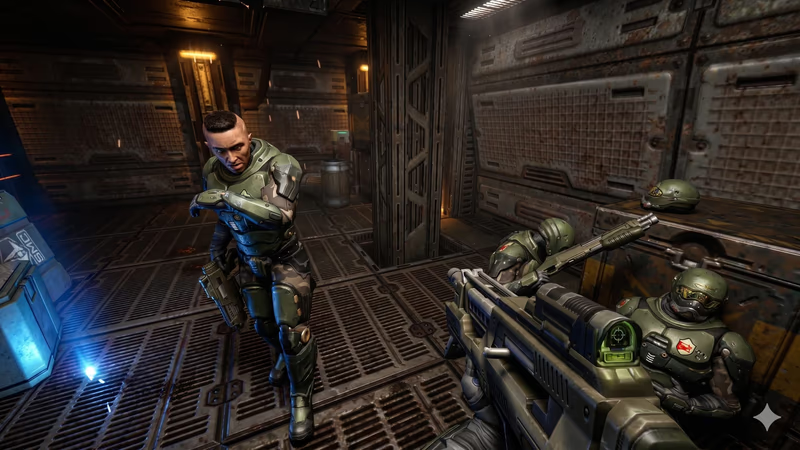
Image captured on Xbox 360 and retouched with Nano Banana.
When we talk about the legendary Quake franchise, the conversation usually gravitates toward the speedrunning innovations of the original game or the multiplayer revolution of Quake III Arena. However, sitting quietly in the middle of the 2000s is a title that delivered one of the darkest, most brutal, and unforgettable single-player campaigns of its era: Quake 4. Released in 2005 as a collaborative effort between id Software and Raven Software, this game picked up right where Quake II left off.
The Premise: You Are No Longer Alone
Unlike previous iterations where you played as a solitary marine taking on an entire alien army, Quake 4 places you in the boots of Corporal Matthew Kane, a new addition to the elite Rhino Squad. Earth’s forces are launching a massive, desperate counter-invasion against Stroggos, the home planet of the Strogg—a cybernetic alien race that harvests other species for spare parts.
The game heavily channels the military sci-fi vibes of movies like Aliens or Starship Troopers. You fight alongside AI-controlled squadmates who actively contribute to your survival. Medics heal you, and technicians repair your armor on the fly. This dynamic completely shifts the tone of the game; you are not a lone wolf, but a cog in a massive, chaotic war machine pushing through enemy lines.
The Turning Point: The "Stroggification"
About halfway through the campaign, Quake 4 delivers one of the most infamous and traumatic sequences in first-person shooter history. Kane is captured by the enemy and sent to a Strogg medical facility to be "processed."
Told entirely from a locked first-person perspective, players are forced to watch helplessly as Kane goes through the horrific assembly line of Stroggification. You witness terrifying machines inject glowing fluids into your chest, a circular saw amputate your legs, and robotic prosthetics being violently bolted onto your bleeding stumps. It is a masterclass in interactive body horror.
However, this is not just a narrative shock factor; it profoundly changes the gameplay. Rescued just before his brain is chipped, Kane becomes a half-Strogg hybrid. Suddenly, your movement speed increases dramatically, you can understand the alien text on computer terminals, and you can use the Strogg's own health stations to heal. It shifts the pacing from a methodical tactical shooter to the fast-paced, relentless action the Quake series is known for.
Gameplay and Arsenal
Quake 4 respects its roots when it comes to firepower. The weapons feel incredibly heavy and satisfying to use. Returning classics like the Hyperblaster, the Rocket Launcher, and the devastating Railgun are joined by a fantastic iteration of the Nailgun.
To keep the arsenal fresh, Raven Software introduced a clever upgrade system. Throughout the campaign, allied technicians will modify your weapons—giving your machine gun an extended magazine or adding a lock-on feature to your rocket launcher. Furthermore, the game breaks up the claustrophobic corridor shooting with surprisingly fun vehicle sections, letting you pilot Hovertanks and massive Mechs to crush Strogg infantry and bring a sense of massive scale to the planetary war.
Engine
Powered by id Tech 4 (the Doom 3 engine), Quake 4 was a visual powerhouse in 2005. But while Doom used the engine to hide demons in pitch-black corners, Quake 4 used it to highlight a grotesque, industrialized nightmare.
The lighting perfectly illuminates the rusted metal, exposed wires, and raw flesh that make up the Strogg architecture. The enemy design is equally repulsive and fascinating. From zombified space marines begging for death to the towering, rocket-equipped Gladiators and the agile Tactical Stroggs, the visual design constantly reinforces the terrifying reality of the alien threat.
While the single-player campaign was a triumph, the multiplayer component received a more lukewarm reception. Raven Software took a very conservative approach, essentially creating a direct homage to Quake III Arena. It featured the same fast-paced movement, including strafe jumping and rocket jumping, and brought back classic maps alongside new ones.
While mechanically sound, it struggled to find a massive audience. By 2005, the multiplayer landscape was rapidly evolving with heavy hitters like Battlefield 2 and Halo 2, making the traditional arena shooter formula feel a bit dated to the mainstream crowd. It remained a solid addition, but it never managed to dethrone its legendary predecessor.
Pros & Cons
Pros:
Intense Atmosphere and Dread: The game masterfully builds a constant sense of fear and unease, keeping you on edge with the sudden, unpredictable appearance of horrifying Strogg enemies ambushing you from the shadows.
Iconic Body Horror: The mid-game "Stroggification" scene remains one of the most chilling, memorable, and brilliantly executed first-person sequences in gaming history.
Heavy, Satisfying Arsenal: Weapons like the Nailgun, Rocket Launcher, and Railgun feel incredibly punchy, and the squad-based upgrade system keeps the gunplay evolving.
Superb Lighting and Industrial Design: Running on the id Tech 4 engine, the dynamic shadows and gruesome fusion of flesh and rusted metal create a visually striking, oppressive alien world.
Dynamic Squad Mechanics: Fighting alongside AI squadmates who actively heal you and repair your armor makes you feel like part of a large-scale, desperate military invasion.
Cons:
Clunky Movement Physics: The character movement can occasionally feel strange and rigid when navigating the environment, with floaty jumping mechanics and awkward collision detection on terrain.
Predictable Level Design: Despite the great art direction, the campaign relies heavily on repetitive, claustrophobic corridors and linear "find the switch to open the door" progression.
Vehicular Sections Lack Polish: While intended to break up the pacing, the Hovertank and Mech sections feel sluggish and stripped of the tight controls found in the core on-foot gunplay.
Underwhelming Multiplayer: The online modes took few risks, offering a conservative rehash of Quake III Arena that felt dated compared to other innovative multiplayer shooters of the mid-2000s.
Conclusion
Quake 4 stands as a testament to a bygone era of first-person shooters. It is a game from a time when linear, highly polished, and brutally uncompromising single-player campaigns dominated the market—long before the days of live-service models and microtransactions.
Today, it remains a cult classic. Its seamless blend of intense military action and deeply disturbing body horror creates an atmosphere that very few games have managed to replicate. If you are a fan of old-school shooters, dark sci-fi, and don't mind getting your hands dirty with a little motor oil and blood, Quake 4 is a biomechanical nightmare that absolutely demands to be played.
Affiliate link: Support the blog via Instant Gaming at no extra cost.
Master the skies of Strangereal in Ace Combat 7. Learn expert flight controls, High-G turns, atmospheric survival, and the optimal special weapon loadout for all 20 campaign missions.
Lost Odyssey Weapon Guide: Best Endgame Weapons for Every Character
Unlock the ultimate weapons for Kaim, Seth, Ming, Sarah, and all mortal party members in Lost Odyssey. Learn exact stats, locations, and crafting steps.
Coordinates, Spawns, and Secrets in Shin Chan's Summer Vacation. These top-tier specimens are the most elusive creatures in the game. Catching them is not just a badge of honor for completionists, it is the ultimate key to securing the most
The Order: 1886 transports us to a beautifully grim, smog-choked 19th-century London. But this is not the London of Charles Dickens; it's a battleground.
Minecraft Dungeons DLC Guide: Every Expansion Ranked & Analyzed
Are the Minecraft Dungeons DLCs worth buying? We break down all 6 expansions, their biomes, unique mechanics, boss fights, and rank the absolute must-haves.
Analysis of the PlayStation 4 and PS4 Pro hardware. We examine the shared CPU bottleneck, the mirrored butterfly GPU design, memory optimizations, and the hardware-level checkerboard rendering that enabled the 4K transition.
PlayStation 5 Pro hardware: PSSR, Advanced Ray Tracing, and the AI Revolution. We analyze Sony's PlayStation Spectral Super Resolution (PSSR), RDNA 4 Ray Tracing advancements, and the engineering behind the end of the Fidelity vs. Performance compromise.
guides
Minecraft Dungeons Boss Guide: Strategies to Defeat Every Boss
Conquer the toughest bosses in Minecraft Dungeons. Master attack patterns, exploit weak points, and equip the best builds for every major fight.