The Silicon Gamble: Review of the Xbox 360
We dissect the brilliant foresight of its unified shader architecture and digital ecosystem, while critically examining the catastrophic thermal engineering failure of the "Red Ring of Death."

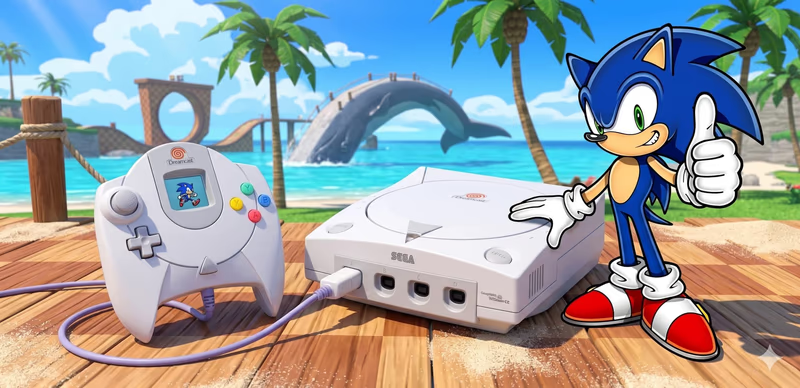
Nano Banana

An analytical autopsy of a machine that traveled from the future only to die too soon. We explore the brilliant, hyper-efficient engineering of the Sega Dreamcast, its pioneering steps into online console gaming, and the heartbreaking corporate realities that forced the beloved hardware giant to bow out of the console race forever. It is a story of ultimate technical redemption overshadowed by inescapable financial tragedy.
By 1997, Sega was bleeding out. The convoluted architecture of the Sega Saturn had alienated third-party developers, and a series of prior hardware missteps (the Sega CD and 32X) had eroded consumer trust in the West. Sega desperately needed a clean slate—a machine that was powerful, affordable, and, above all, incredibly easy to program for.
The urgency led to a fascinating corporate civil war. Sega's executives pitted two independent engineering teams against each other to design the next console. In the United States, Tatsuo Yamamoto led a secret team developing "Black Belt," a prototype utilizing 3Dfx’s immensely popular Voodoo PC graphics architecture. Simultaneously in Japan, Hideki Sato’s team developed "Katana," utilizing a lesser-known NEC/VideoLogic PowerVR graphics chip.
When 3Dfx prematurely leaked their involvement with Sega during their Initial Public Offering (IPO), an infuriated Sega of Japan severed ties and officially chose the "Katana" design. This decision had dire consequences: 3Dfx sued Sega, and more importantly, Electronic Arts (EA)—who had close ties with 3Dfx—swore off the Dreamcast entirely, depriving the console of crucial sports titles like Madden and FIFA.
Despite the boardroom drama, the hardware that emerged from the "Katana" project was nothing short of a masterpiece. Sega had learned from the Saturn’s dual-CPU nightmare; the Dreamcast was built on a philosophy of streamlined elegance.
Sega didn't just innovate on the motherboard; they fundamentally rethought how players interacted with the machine and the world.
The Dreamcast library, though short-lived, is one of the most densely packed collections of innovative software in gaming history.
The Dreamcast launched in North America on September 9, 1999 (9/9/99), setting the record for the most successful hardware launch in entertainment history at the time. For a brief, glorious moment, Sega was back on top.
But the shadow of Sony was looming. Sony unleashed a masterclass in psychological marketing, promoting the upcoming PlayStation 2 not just as a vastly superior supercomputer, but as an affordable DVD player. Consumers willingly held onto their money, deciding to wait for the PS2.
Simultaneously, the Dreamcast's anti-piracy measures were completely shattered. Hackers discovered the "MIL-CD" exploit, which allowed anyone to burn Dreamcast games onto standard CD-Rs without even modifying the console's hardware. Software sales plummeted.
Bleeding cash, unable to afford a price war with Sony, and facing a massive corporate restructuring, Sega's executives made a heartbreaking choice. In January 2001, less than two years after its triumphant Western launch, Sega announced the discontinuation of the Dreamcast. The pioneer of the 16-bit era was abandoning the hardware market forever to become a third-party software publisher.
The Dreamcast died a corporate death, but it never lost its soul, nor its community. Today, it stands as the ultimate cult-classic console.
Because of its architecture and the MIL-CD exploit, it is a haven for the homebrew community. Independent developers are still coding and releasing brand-new, physical Dreamcast games to this very day. Furthermore, dedicated hardware preservationists have developed tools like the "DreamPi"—a custom Raspberry Pi setup that tricks the console's modem into connecting to modern broadband networks. Decades after Sega pulled the plug, you can still log on and play Quake III Arena or Phantasy Star Online with people around the world.
The Sega Dreamcast was a brilliant, uncompromising machine that arrived exactly when the world needed it, but precisely when Sega could least afford it. It remains a poignant monument to the golden age of arcade gaming—a beautiful dream that woke up too soon.

Affiliate link: Support the blog via Instant Gaming at no extra cost.
Sega Dreamcast
Others Posts
We dissect the brilliant foresight of its unified shader architecture and digital ecosystem, while critically examining the catastrophic thermal engineering failure of the "Red Ring of Death."
We explore how the Switch OLED prioritizes sensory refinement over brute force, pairing a stunning, high-contrast display and superior engineering with one of the greatest software libraries in gaming history.
An exhaustive historical and technical autopsy of the Sega Genesis. We explore how Sega weaponized a legendary Motorola processor and an aggressive FM synthesizer

An analytical case study of the Nintendo Entertainment System. We explore how Nintendo merged highly efficient 8-bit silicon with aggressive hardware-based DRM (the 10NES chip) and ingenious industrial design
A technical breakdown of the PlayStation 3's engineering and market performance. We examine the notoriously complex Cell Broadband Engine, the split-memory bottleneck.

The PlayStation 5 hardware architecture. We analyze Mark Cerny's custom I/O complex, the revolutionary 825GB SSD, liquid metal thermal engineering, and how Sony eradicated the traditional storage bottleneck.


RoboCop: Rogue City: Teyon's faithful adaptation, Peter Weller's return, the sheer power of the Auto-9, and the gritty streets of Old Detroit.

Mutant Year Zero: Road to Eden: XCOM-style tactical combat, real-time stealth infiltration with Dux and Bormin, and the secrets of The Zone.
Conquer the toughest bosses in Minecraft Dungeons. Master attack patterns, exploit weak points, and equip the best builds for every major fight.
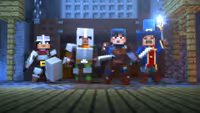
Are the Minecraft Dungeons DLCs worth buying? We break down all 6 expansions, their biomes, unique mechanics, boss fights, and rank the absolute must-haves.
games
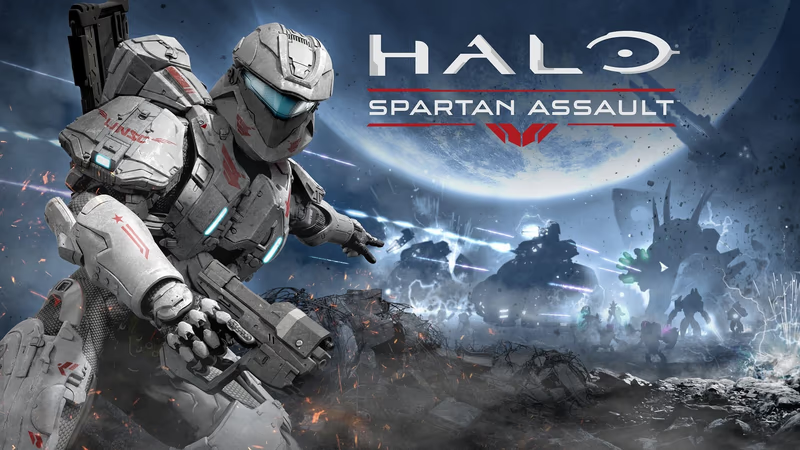
Halo: Spartan Assault: 343 Industries' jump into the twin-stick shooter genre, the battles of Sarah Palmer, and the heavy baggage of its mobile origins.