The Swan Song of Silicon: A Technical Review of the Sega Dreamcast
An analytical autopsy of a machine that traveled from the future only to die too soon. We explore the brilliant, hyper-efficient engineering of the Sega Dreamcast.

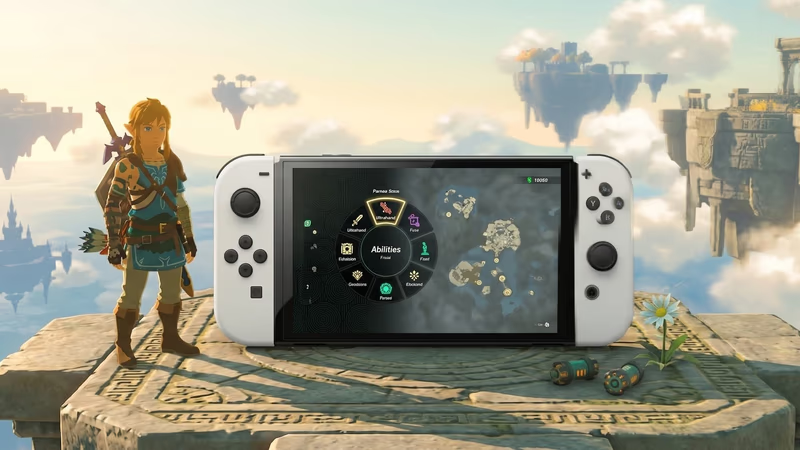
Nano Banana
A technical analysis of Nintendo's premium mid-cycle revision. We explore how the Switch OLED prioritizes sensory refinement over brute force, pairing a stunning, high-contrast display and superior engineering with one of the greatest software libraries in gaming history.
In the years leading up to 2021, the gaming industry was consumed by rumors of a "Switch Pro." Analysts and insiders confidently predicted a machine capable of 4K resolution via Nvidia's DLSS technology, alongside significant CPU and GPU upgrades to bridge the gap with the PlayStation 5 and Xbox Series X.
When Nintendo finally unveiled the Switch OLED, the reaction was a mix of surprise and, in some corners, disappointment. However, from a corporate and hardware strategy perspective, Kyoto's decision was a masterstroke of restraint. Instead of fracturing their massive install base with hardware-exclusive games or engaging in a costly teraflop arms race, Nintendo opted for a purely sensory upgrade. The goal was not to change what the console could render, but to radically enhance how the player perceived those renders.
As hardware journalists, we must address the elephant in the room: the internal processing power of the Switch OLED is completely identical to the standard 2019 model.
This is the mechanical heart of the revision. Nintendo replaced the original 6.2-inch LCD screen with a vibrant 7-inch OLED panel manufactured by Samsung.
The Switch OLED feels like a premium adult device compared to the toy-like nature of the original launch model.
Hardware is merely a vessel for software, and the Switch OLED benefits from arguably the strongest library in Nintendo’s storied history. The brilliance of the OLED panel is that it acts as an automatic, free remaster for older titles.
The Nintendo Switch OLED is a masterclass in mid-cycle hardware iteration. It is not the most powerful machine on the market—far from it. But by surgically targeting the screen, the speakers, and the physical build quality, Nintendo created a device that feels profoundly luxurious to use.
It proves that in the realm of portable gaming, raw teraflops can often be outmatched by a flawless sensory experience and a peerless library of games. The Switch OLED is the ultimate, perfected form of the hybrid console concept, standing as a legendary piece of hardware before the industry inevitably moves toward Nintendo's next generation.

Affiliate link: Support the blog via Instant Gaming at no extra cost.
Nintendo Switch
Others Posts
An analytical autopsy of a machine that traveled from the future only to die too soon. We explore the brilliant, hyper-efficient engineering of the Sega Dreamcast.
A definitive technical clash between two titans of modern handheld gaming. We break down the closed-ecosystem optimization of Nintendo's ARM architecture against the raw x86 brute force of Valve's portable PC.

We dissect the brilliant foresight of its unified shader architecture and digital ecosystem, while critically examining the catastrophic thermal engineering failure of the "Red Ring of Death."

We analyze the technological differences between LCD and OLED panels, redesigned acoustics, and connectivity to determine if the sensory upgrade justifies the generational leap.
We explore how a broken handshake between Nintendo and Sony birthed a 32-bit titan. By combining developer-friendly hardware, the vast storage of the CD-ROM, and an aggressive marketing strategy

We explore how Nintendo traded teraflops for accessibility, turning a glorified remote control into a global cultural phenomenon that brought gaming to living rooms, retirement homes, and the masses.


RoboCop: Rogue City: Teyon's faithful adaptation, Peter Weller's return, the sheer power of the Auto-9, and the gritty streets of Old Detroit.

Mutant Year Zero: Road to Eden: XCOM-style tactical combat, real-time stealth infiltration with Dux and Bormin, and the secrets of The Zone.
Conquer the toughest bosses in Minecraft Dungeons. Master attack patterns, exploit weak points, and equip the best builds for every major fight.

Are the Minecraft Dungeons DLCs worth buying? We break down all 6 expansions, their biomes, unique mechanics, boss fights, and rank the absolute must-haves.
games
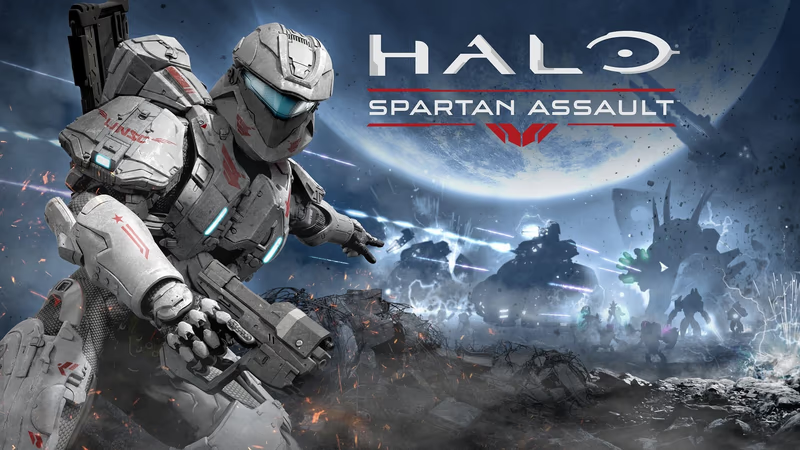
Halo: Spartan Assault: 343 Industries' jump into the twin-stick shooter genre, the battles of Sarah Palmer, and the heavy baggage of its mobile origins.