Nintendo Switch vs. Switch OLED: A Technical Hardware Comparison
We analyze the technological differences between LCD and OLED panels, redesigned acoustics, and connectivity to determine if the sensory upgrade justifies the generational leap.

Nano Banana
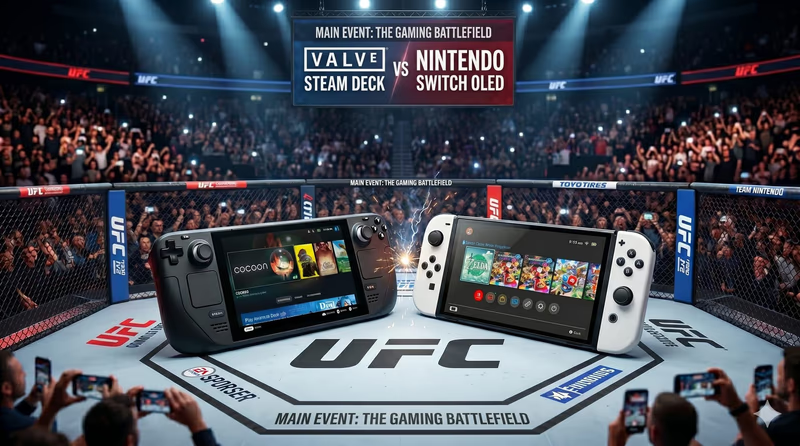
A definitive technical clash between two titans of modern handheld gaming. We break down the closed-ecosystem optimization of Nintendo's ARM architecture against the raw x86 brute force of Valve's portable PC. This is an in-depth look at how the Nintendo Switch OLED and the Steam Deck represent two fundamentally opposing, yet highly successful, philosophies in portable gaming.
We are witnessing a fascinating schism in the hardware industry. Unlike traditional console wars where competitors essentially built identical boxes to perform the same task, the Nintendo Switch OLED and the Steam Deck represent a complete clash of philosophies.
The Switch OLED is the absolute refinement of a hybrid concept born in 2017. It is a dedicated, closed-ecosystem gaming console built on the promise of immediate accessibility: pick it up, turn it on, and play. The Steam Deck, conversely, is Valve's audacious experiment to emancipate the PC gaming library from the desktop. Following the commercial failure of the Steam Machines, Valve engineered a disruptive piece of hardware designed to put the raw power, complexity, and absolute freedom of a personal computer directly into your hands.
As hardware analysts, this is where the comparison becomes incredibly intriguing. We cannot simply compare these machines teraflop-for-teraflop because their underlying architectural DNA is entirely different.
The physical footprint of these devices dictates how and where they are meant to be used.
The deciding factor for many consumers will not be the silicon, but the software environment.
Power output directly correlates with power consumption, and this is where the architectural differences become starkly visible.
Ultimately, these two devices are not mutually exclusive; they serve entirely different demographics.
You should buy the Nintendo Switch OLED if: You value immediate, plug-and-play simplicity. It is the undisputed king for local couch multiplayer, frequent flyers looking for maximum battery life in a slim profile, and anyone who considers Nintendo's legendary first-party franchises essential to their gaming diet.
You should buy the Steam Deck if: You are a hardware enthusiast or a veteran PC gamer. If you already have a massive backlog on Steam, crave the freedom to tweak graphics settings, enjoy the "tinkering" aspect of open platforms, and want the ability to play massive, AAA desktop titles from the comfort of your couch, the Steam Deck is an unprecedented technological triumph.

Affiliate link: Support the blog via Instant Gaming at no extra cost.
Nintendo Switch
Steam Deck OLED
Others Posts
We analyze the technological differences between LCD and OLED panels, redesigned acoustics, and connectivity to determine if the sensory upgrade justifies the generational leap.
We explore how the Switch OLED prioritizes sensory refinement over brute force, pairing a stunning, high-contrast display and superior engineering with one of the greatest software libraries in gaming history.

Analysis of the PlayStation 4 and PS4 Pro hardware. We examine the shared CPU bottleneck, the mirrored butterfly GPU design, memory optimizations, and the hardware-level checkerboard rendering that enabled the 4K transition.
We explore how a broken handshake between Nintendo and Sony birthed a 32-bit titan. By combining developer-friendly hardware, the vast storage of the CD-ROM, and an aggressive marketing strategy

Two decades later, Valve’s magnum opus remains the undisputed gold standard for first-person shooters and a towering legend in the interactive medium.

A technical and historical breakdown of the Nintendo Wii U. We examine how its architectural bottlenecks, confusing marketing, and miraculous low-latency GamePad created a commercial failure that ultimately served as the essential prototype for Nintendo's modern hardware dominance.


RoboCop: Rogue City: Teyon's faithful adaptation, Peter Weller's return, the sheer power of the Auto-9, and the gritty streets of Old Detroit.

Mutant Year Zero: Road to Eden: XCOM-style tactical combat, real-time stealth infiltration with Dux and Bormin, and the secrets of The Zone.
Conquer the toughest bosses in Minecraft Dungeons. Master attack patterns, exploit weak points, and equip the best builds for every major fight.

Are the Minecraft Dungeons DLCs worth buying? We break down all 6 expansions, their biomes, unique mechanics, boss fights, and rank the absolute must-haves.

games
Halo: Spartan Assault: 343 Industries' jump into the twin-stick shooter genre, the battles of Sarah Palmer, and the heavy baggage of its mobile origins.