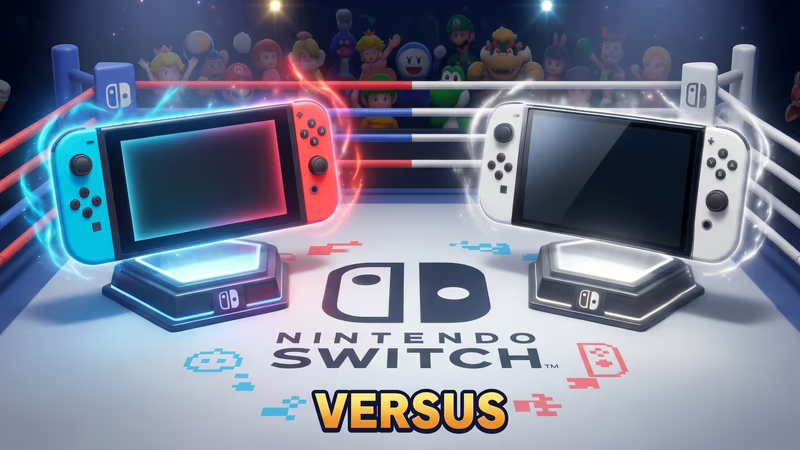
We analyze the technological differences between LCD and OLED panels, redesigned acoustics, and connectivity to determine if the sensory upgrade justifies the generational leap.
Introduction: Two Screens, One Silicon Heart
When comparing the standard Nintendo Switch (specifically the 2019 "V2" model) and the Switch OLED, we must first address the elephant in the room: from a computational standpoint, these two machines are identical clones.
Both consoles are powered by the exact same System-on-a-Chip (SoC): the Nvidia Tegra X1+ (the 16-nanometer "Mariko" revision), paired with 4 GB of LPDDR4 RAM. This means that a demanding game like The Legend of Zelda: Tears of the Kingdom will render at the exact same internal resolution and target the exact same framerate on both devices. The evolution of the OLED model does not lie in raw teraflops or processing brute force, but rather in how the hardware projects that rendered image to our senses.
Panel War: IPS LCD vs. OLED (The Core Debate)
The fundamental justification for the OLED model's existence lies entirely in its display technology.
- Standard Switch (6.2" IPS LCD): The base model utilizes a standard In-Plane Switching Liquid Crystal Display. By design, this technology requires a global LED backlight sitting behind the pixel layer to illuminate the screen. Because this backlight is always on, light inevitably bleeds through the dark areas of the image. Consequently, "blacks" on a standard Switch often appear as dark, washed-out greys, severely limiting the overall contrast ratio.
- Switch OLED (7.0" Samsung OLED): The premium model utilizes an Active-Matrix Organic Light-Emitting Diode display. In an OLED panel, there is no global backlight; every single pixel generates its own light autonomously. When the image calls for black, those specific pixels simply turn off entirely. This creates a mathematically infinite contrast ratio, resulting in true, inky blacks and incredibly vibrant, hyper-saturated colors. Furthermore, Nintendo engineered thinner bezels to fit a 7-inch screen into roughly the same physical footprint as the original, and utilized a fully laminated glass front (removing the air gap) to bring the image much closer to the user's eyes.
Mechanical Engineering and Materials: From Plastic to Magnesium
Beyond the screen, the build quality received a significant, highly necessary overhaul.
- The Kickstand (Standard): The original console features a small, asymmetrical, flimsy plastic leg that doubles as a cover for the MicroSD card slot. It offers only one precarious viewing angle and is notoriously prone to snapping off under light pressure.
- The Kickstand (OLED): Nintendo replaced the plastic leg with a premium, full-width friction hinge machined from a magnesium alloy. Not only does this allow for infinite, sturdy viewing angles in tabletop mode, but the magnesium plate also significantly improves the overall torsional rigidity of the entire chassis.
- Thermal Management & Tolerances: The OLED model features a slightly redesigned thermal exhaust grill that is better protected against dust. Additionally, the metal rails that hold the Joy-Cons have tighter manufacturing tolerances, noticeably reducing the annoying "wobble" that plagued older standard models.
Redesigned Acoustics: Open vs. Closed-Box
A screen upgrade demands an audio upgrade, and Nintendo's acoustic engineers delivered a clever solution.
- Standard Switch: The base model uses traditional open-backed speakers. Because these speakers share the internal acoustic space with the battery, motherboard, and cooling fan, the sound waves disperse inside the chassis, resulting in audio that can sound thin and tinny at high volumes.
- Switch OLED: The new model introduces "closed-box" speaker modules. By fully encapsulating the speaker driver in its own sealed acoustic chamber, Nintendo prevents sound waves from bouncing around the internal components. This seemingly small engineering tweak results in significantly higher sound pressure, cleaner highs, and remarkably punchier bass without any chassis-rattling distortion.
The Dock and Connectivity: The Importance of the LAN Port
The dock that connects the console to the television also received a quiet but vital internal redesign.
- Standard Dock: The original base relies entirely on an internal Wi-Fi chip that is notoriously weak. To get a wired internet connection, users are forced to buy a separate third-party USB 3.0 LAN adapter.
- OLED Dock: The redesigned base features a built-in Realtek network controller and an integrated LAN (Ethernet) port directly on the mainboard. For players invested in highly competitive, frame-perfect games like Super Smash Bros. Ultimate or Splatoon 3, this native wired connection drastically reduces ping and packet jitter. Additionally, the new dock features softer internal plastics to prevent the console's screen from scratching during insertion, along with a wider passive airflow channel.
Internal Storage: eMMC Flash
The storage capacity saw a modest bump, but the underlying technology remains identical.
The Standard Switch ships with 32 GB of internal storage, while the Switch OLED doubles this to 64 GB. However, it is crucial to note that both machines utilize the exact same eMMC (Embedded MultiMediaCard) protocol. This means that while you can hold more games on the OLED model out of the box, the read and write speeds—and therefore the game loading times—are functionally identical across both systems.
Technical Verdict: User Profiles
Because the processing power is identical, choosing between these two consoles comes down strictly to your physical gaming habits.
Who should buy (or keep) the Standard Switch? The dedicated home console player. If your Switch spends 90% of its life sitting in the dock connected to a television, the standard model is the logical choice. Once docked, the OLED screen shuts off and the closed-box speakers are muted. In docked mode, the $350 Switch OLED performs exactly the same as the $300 standard model.
Who should buy the Switch OLED? The handheld and tabletop enthusiast. If you play on the couch, on your commute, or in bed, the OLED model is a revelation. The infinite contrast of the panel, the larger screen real estate, the vastly superior magnesium ergonomics, and the punchy acoustics easily justify the premium price tag. It is the definitive, uncompromised way to experience the Nintendo hybrid catalog.