We explore how a broken handshake between Nintendo and Sony birthed a 32-bit titan. By combining developer-friendly hardware, the vast storage of the CD-ROM, and an aggressive marketing strategy that made gaming "cool" for adults, the PlayStation didn't just win a console war—it fundamentally changed the demographic of the entire industry.
A Broken Handshake at CES 1991
To understand the PlayStation, we must first look at the greatest strategic blunder in corporate gaming history. In the late 1980s, Sony was not a gaming company; they were an electronics and music giant. However, a brilliant and stubborn Sony engineer named Ken Kutaragi had secretly designed the SPC-700 audio chip for Nintendo’s Super Famicom (SNES). Impressed, Nintendo entered into a joint venture with Sony to create a CD-ROM add-on for the SNES, as well as a standalone Sony console that played both SNES cartridges and CDs. It was dubbed the "Play Station."
The moment of absolute betrayal occurred at the Summer Consumer Electronics Show (CES) in June 1991. Sony proudly announced the "Play Station" to the world. The very next morning, at the same trade show, Nintendo executive Howard Lincoln stepped onto the stage and announced that Nintendo was breaking its contract with Sony and partnering with their European rival, Philips, instead.
Sony was publicly humiliated. Corporate executives wanted to scrap the project and exit the gaming industry entirely. But Kutaragi approached Sony President Norio Ohga, appealing to his pride and anger over Nintendo's treachery. Kutaragi promised a machine that would render 3D graphics unlike anything the world had seen. Enraged by the betrayal, Ohga famously gave Kutaragi the green light. The PlayStation was no longer just a business venture; it was an act of silicon vengeance.
Hardware Architecture
Unlike Sega, who panicked and bolted a second CPU onto the Saturn, Ken Kutaragi designed the PlayStation with a singular, beautiful philosophy: make it incredibly powerful for 3D math, and impossibly easy to program.
- The Brains: The system ran on a custom 32-bit MIPS R3000A RISC processor clocked at 33.86 MHz. It was a clean, elegant architecture. Sony provided developers with robust C-language libraries, liberating them from the nightmare of coding in assembly language, which was the industry standard at the time.
- The GTE (Geometry Transformation Engine): This was Kutaragi’s secret weapon. Integrated directly alongside the CPU, the GTE was a dedicated math coprocessor designed solely to calculate 3D geometry and lighting. It allowed the console to push an astonishing 360,000 flat-shaded polygons per second.
- The "Wobbly Polygon" Phenomenon: As a hardware analyst, examining the PS1's visual quirks is fascinating. To save memory and cost, the PS1 lacked a Z-buffer (which tracks the depth of polygons) and used affine texture mapping (which calculates textures in 2D space without perspective correction). This resulted in the console's trademark visual signature: 3D models that seemed to "tremble" at the edges, and textures that severely warped and skewed when the camera got close to them. It was a technical compromise, but it gave PS1 games an unforgettable aesthetic.
The move from cartridges to optical media destroyed the old world order of video game publishing.
- The Power of the CD-ROM: The double-speed (2x) CD-ROM drive utilized discs that held 650 MB of data. This was an ocean of space compared to a 12 MB N64 cartridge. It allowed for fully voiced dialogue, CD-quality orchestral soundtracks (Red Book Audio), and cinematic Full Motion Video (FMV) cutscenes.
- The Economics of the Disc: This is where Sony truly defeated Nintendo. A cartridge cost upwards of $15 to manufacture and took months to produce. A CD cost pennies and could be pressed in days. Third-party publishers flocked to Sony because the profit margins were astronomical, and inventory risks were eliminated.
- Memory Cards: Because CDs could not save data, Sony introduced standardized 1 MB flash Memory Cards (divided into 15 blocks). Taking your Memory Card to a friend's house to load up your saved game became a definitive ritual of the 90s.
Demographic Shift and Marketing
Sony realized that the children who grew up playing the NES in the 1980s were now teenagers and young adults. They moved the console out of the toy aisle and into the nightclub.
Sony deployed aggressive, avant-garde marketing campaigns (like the famous "U R Not E" advertisements in America). In Europe, they set up PlayStation kiosks in underground techno clubs. Games like Wipeout featured licensed soundtracks from real-world electronic artists like The Chemical Brothers and The Prodigy, alongside sleek graphic design by The Designers Republic. Playing video games was no longer something you hid; it was an integral part of 90s pop culture.
The Catalog: The Dawn of Modern Franchises
The third-party migration to PlayStation birthed franchises that still dominate the industry today.
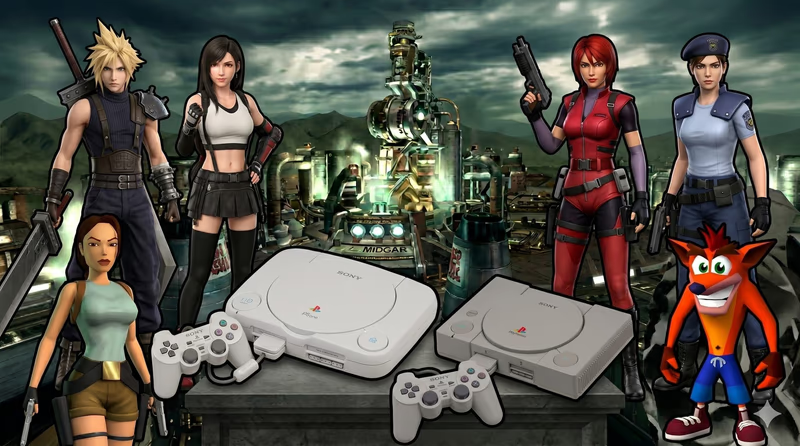
- The Ultimate Heist: Final Fantasy VII was the nail in Nintendo's coffin. Square Soft realized their cinematic vision required the massive storage of CDs, abandoning Nintendo after a decade-long partnership. FF7 spanned three discs and sold over 10 million copies, popularizing the JRPG genre in the West.
- Cinematic Gameplay: Hideo Kojima’s Metal Gear Solid proved that video games could rival Hollywood in narrative scope and voice acting.
- Defining Genres: Capcom’s Resident Evil coined the term "survival horror," while Polyphony Digital’s Gran Turismo utilized real-world physics to create the most comprehensive driving simulator the world had ever seen.
Hardware Revisions, Sales, and Discontinuation
The life cycle of the PlayStation hardware was a testament to iterative engineering, albeit with some early hiccups.
- The Laser Sled Issue: Early models (SCPH-1000 to 3000) suffered from a notorious thermal design flaw. The laser assembly was positioned too close to the power supply, and the plastic rails it slid on would wear down from the heat, causing the laser to tilt and FMVs to skip violently. The legendary user fix? Flipping the entire console upside down to let gravity realign the laser. Sony silently fixed this in later motherboard revisions.
- The PS One: In 2000, Sony released the PS One, a drastically miniaturized, beautifully rounded redesign that prolonged the console's life for years, even after the PS2 launched.
- Commercial Impact: The PlayStation achieved an absolute monopoly. It became the first computer entertainment platform to ship over 102.49 million units worldwide, crushing the Sega Saturn and leaving the Nintendo 64 fighting for a distant second place. Production finally ceased in 2006, giving the machine an astonishing 11-year lifespan.
The Legacy
The original PlayStation is the dividing line between the classic era of gaming and the modern industry.
Hardware-wise, it gave us the DualShock controller in 1997. By introducing twin symmetrical analog sticks and dual rumble motors, Sony established the ergonomic blueprint that every console manufacturer still follows today. Corporately, it taught the industry a brutal lesson: hubris can be fatal. Nintendo’s decision to betray Sony and cling to the cartridge cost them their absolute dominance of the living room.
The PlayStation proved that video games were a mature, global, multi-billion-dollar entertainment medium. Ken Kutaragi didn't just get his revenge; he built an empire.