We explore how Nintendo traded teraflops for accessibility, turning a glorified remote control into a global cultural phenomenon that brought gaming to living rooms, retirement homes, and the masses.
The Ashes of the GameCube and "Project Revolution"
To understand the Wii, we must look at the bruised ego of a giant. By 2004, Nintendo was facing an existential crisis. The Nintendo 64 had lost its crown to the original PlayStation, and the purple, lunchbox-shaped GameCube was being thoroughly crushed by the DVD-playing juggernaut that was the PlayStation 2 and the technologically superior Microsoft Xbox.
If Nintendo continued to fight in the "Red Ocean"—a blood-soaked, highly competitive market where hardcore gamers debated polygon counts and processing power—they risked being pushed out of hardware entirely. Enter Satoru Iwata. The late, visionary Nintendo President decided on a radical shift: instead of fighting for the same hardcore demographic, Nintendo would create a "Blue Ocean" by targeting people who had never touched a controller. The internal codename for the console was absolutely fitting: Project Revolution. Shigeru Miyamoto and hardware engineer Genyo Takeda spearheaded a design philosophy focused on destroying the barrier to entry. The intimidating, multi-button controller was out; a design mimicking an ordinary TV remote was in.
The Heart of the Machine: "Recycled" but Efficient Hardware
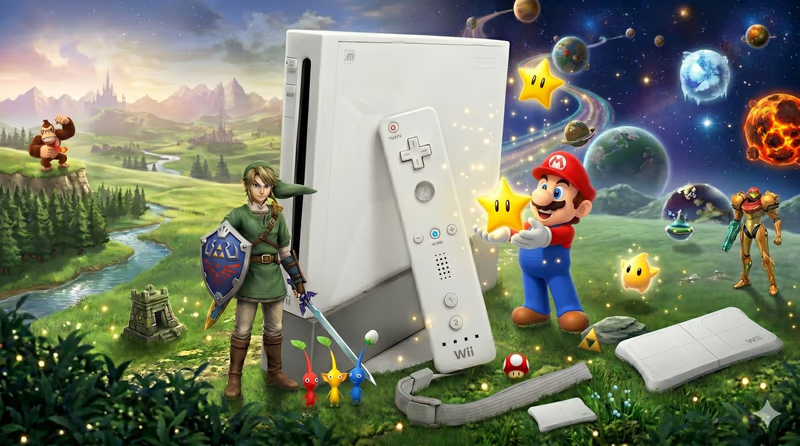
As hardware analysts, we often obsess over silicon, but opening up a Nintendo Wii reveals a fascinating exercise in restraint. The Wii was not a powerhouse; it was, effectively, two GameCubes duct-taped together.
- Processors: It ran on a 729 MHz IBM "Broadway" CPU paired with a 243 MHz ATI "Hollywood" GPU.
- The HD Gamble: In 2006, as Sony and Microsoft were heavily pushing High Definition (HD) gaming, Nintendo made the controversial, cost-saving decision to cap the Wii at 480p resolution.
- Thermals and Power: This is where Takeda’s engineering brilliance shone. While the early Xbox 360s and PS3s were melting themselves under massive thermal loads (resulting in the infamous Red Ring of Death and Yellow Light of Death), the Wii was a whisper-quiet, ultra-reliable machine. It consumed a meager 18 watts under full load compared to the 200 watts of its rivals. It was designed to be left on 24/7, quietly glowing with its blue disc drive light.
Black Magic and Gyroscopes: The Anatomy of the Wiimote
The true hardware revolution was not inside the console box, but in the palm of the player's hand. The Wii Remote (Wiimote) was a masterclass in intuitive interface design.
It utilized an Analog Devices ADXL330 three-axis accelerometer to detect tilt and movement, combined with a PixArt optical sensor at the tip. This camera tracked infrared light emitted by the "Sensor Bar" placed above or below the TV, allowing for precise pointing. Later in its lifecycle, Nintendo introduced the Wii MotionPlus add-on, incorporating a tuning fork gyroscope to finally achieve true 1:1 motion tracking. By mapping real-world physical gestures to in-game actions, Nintendo instantly bridged the gap between gaming and reality.
The Cultural Phenomenon and Commercial Impact
The launch of the Wii in November 2006 was nothing short of a seismic cultural event. The console bypassed traditional gaming demographics entirely. The demand was so rabid that global hardware shortages lasted for nearly two years.
We saw unprecedented scenes: grandparents bowling in retirement homes, physical therapists using the console for rehabilitation, and morning talk-show hosts swinging the white plastic remotes on live television. Gaming had broken out of the teenager's bedroom and taken over the family living room. Nintendo’s "Blue Ocean" strategy was a resounding, unmitigated success, leading to staggering lifetime sales of over 101.6 million units. It outpaced the Xbox 360 and PS3 for years and printed money for Nintendo from day one, as the hardware was sold at a profit.
Software: The Duality of the Library
Hardware is merely potential; the software was the catalyst for the Wii's cultural explosion. However, the library was deeply polarized.
- The Trojan Horse (Wii Sports): Packaged with the console in the West, Wii Sports is arguably the most important pack-in game since Tetris on the Game Boy. It perfectly communicated the console's hook in seconds. Everyone instinctively knew how to swing a tennis racket or roll a bowling ball. It wasn't just a game; it was a social icebreaker that defined the late 2000s.
- Art over Polygons (Super Mario Galaxy): If Wii Sports sold the console, Super Mario Galaxy (2007) proved it was a masterpiece for traditional gamers. Without programmable shaders or HD resolution, Nintendo used pristine art direction, flawless spherical gravity mechanics, and a sweeping orchestrated soundtrack to create one of the highest-rated games of all time. It proved that pure joy and game design could trump raw teraflops.
- Other Highlights: Titles like The Legend of Zelda: Twilight Princess, Metroid Prime 3: Corruption, and the chaotic, best-selling Mario Kart Wii kept the console glued to the top of the charts.
- The Shovelware Tsunami: As journalists, we must acknowledge the dark side of this massive install base. The Wii was flooded with low-budget, low-effort games ("shovelware") from third-party publishers hoping to make a quick buck off casual consumers.
The Sunsets and The Legacy
As the 2010s dawned, the novelty of motion controls began to wear thin. Smartphones emerged as the new kings of casual gaming, and Sony and Microsoft rushed out their own motion peripherals (PlayStation Move and Kinect) in an attempt to capture Nintendo's magic.
The Wii officially ceased production in 2013, making way for the ill-fated Wii U. However, the Wii's legacy is undeniable. It taught the industry that approachability matters just as much as processing power. It proved that a console could be highly profitable without bleeding-edge silicon. The philosophical seeds planted by the Wii—the belief that hardware should adapt to the player's lifestyle—would eventually germinate and blossom into Nintendo's ultimate hybrid masterpiece: the Nintendo Switch.
The Wii didn't just win its generation; it completely changed who we consider a "gamer."