PS3 Hardware Analysis: How the Cell Architecture Almost Broke Sony
A technical breakdown of the PlayStation 3's engineering and market performance. We examine the notoriously complex Cell Broadband Engine, the split-memory bottleneck.

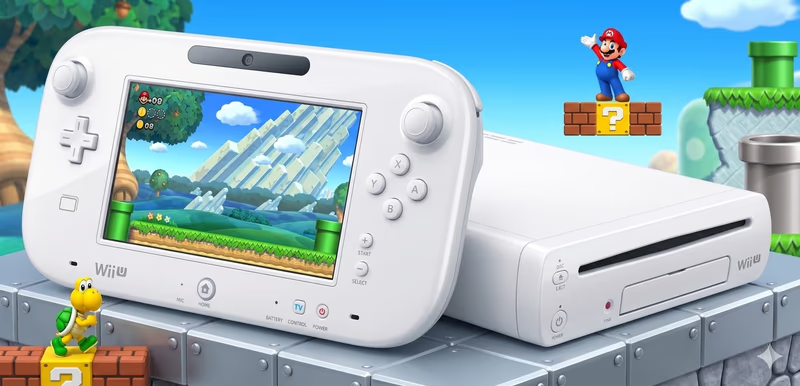
Nano Banana

A technical and historical breakdown of the Nintendo Wii U. We examine how its architectural bottlenecks, confusing marketing, and miraculous low-latency GamePad created a commercial failure that ultimately served as the essential prototype for Nintendo's modern hardware dominance.
To understand the Wii U, we must look at the unprecedented success of its predecessor. The original Wii sold over 100 million units by tapping into a "Blue Ocean" strategy, capturing a massive casual audience. However, as the 2010s began, that casual audience migrated to smartphones. Nintendo faced a severe dilemma: how do you convince an audience that already owns a Wii to buy another, more expensive box?
The answer was a marketing disaster. Unveiled fully at E3 2012, the system was named the "Wii U." Because the initial marketing materials focused almost exclusively on the new tablet controller rather than the console box itself, the general public and mainstream press were profoundly confused. Millions assumed the Wii U GamePad was merely an expensive accessory for the original Wii they already had under their TVs. This fundamental failure in communication crippled the console's momentum before it even launched.
Under the hood, the Wii U was a machine of sharp contrasts. It represented Nintendo's painful, long-overdue transition into High Definition (HD) development, but its silicon was severely bottlenecked by a desire for backward compatibility.
The defining feature of the Wii U was its controller—a bulky tablet with a 6.2-inch screen. It was simultaneously an engineering marvel and a commercial liability.
The internal software environment and market realities quickly isolated the console from the rest of the gaming industry.
Ironically, the console with the worst sales in Nintendo's modern history produced one of the greatest software libraries in the medium.
Initially, Nintendo's internal studios suffered massive delays as they learned the complexities of HD development, causing severe software droughts. However, once they mastered the "Latte" GPU, they produced masterpieces. The Wii U served as the incubator for massive titans: it birthed the Splatoon franchise, delivered the brilliant level design of Super Mario 3D World, hosted Mario Kart 8 (which would go on to become the best-selling racing game in history), and was the foundational development platform for the generation-defining The Legend of Zelda: Breath of the Wild.
The Wii U sold a dismal 13.5 million units before being discontinued, making it a catastrophic commercial failure. However, from a hardware analysis perspective, it was not a mistake; it was a necessary evolutionary link.
The Wii U validated a crucial concept: players loved the ability to play full console games on a portable screen while the living room television was occupied. By taking the painful lessons learned from the Wii U's confusing marketing, its clunky dual-screen OS, and its wireless streaming experiments, Nintendo condensed the entire concept down into a single, elegant, self-contained tablet. The failure of the Wii U was the direct, required prototype that built the Nintendo Switch.

Affiliate link: Support the blog via Instant Gaming at no extra cost.
Wii U
Others Posts
A technical breakdown of the PlayStation 3's engineering and market performance. We examine the notoriously complex Cell Broadband Engine, the split-memory bottleneck.
We examine the cutting-edge implementation of early ARM architecture, the fragmented hardware manufacturing ecosystem, and the fundamental economic flaw in its licensing model that doomed a powerful 32-bit standard to commercial failure.
A definitive technical clash between two titans of modern handheld gaming. We break down the closed-ecosystem optimization of Nintendo's ARM architecture against the raw x86 brute force of Valve's portable PC.

We explore how a broken handshake between Nintendo and Sony birthed a 32-bit titan. By combining developer-friendly hardware, the vast storage of the CD-ROM, and an aggressive marketing strategy

An exhaustive historical and technical autopsy of the Sega Genesis. We explore how Sega weaponized a legendary Motorola processor and an aggressive FM synthesizer
We analyze the technological differences between LCD and OLED panels, redesigned acoustics, and connectivity to determine if the sensory upgrade justifies the generational leap.

RoboCop: Rogue City: Teyon's faithful adaptation, Peter Weller's return, the sheer power of the Auto-9, and the gritty streets of Old Detroit.

Mutant Year Zero: Road to Eden: XCOM-style tactical combat, real-time stealth infiltration with Dux and Bormin, and the secrets of The Zone.
Conquer the toughest bosses in Minecraft Dungeons. Master attack patterns, exploit weak points, and equip the best builds for every major fight.
Are the Minecraft Dungeons DLCs worth buying? We break down all 6 expansions, their biomes, unique mechanics, boss fights, and rank the absolute must-haves.
games
Halo: Spartan Assault: 343 Industries' jump into the twin-stick shooter genre, the battles of Sarah Palmer, and the heavy baggage of its mobile origins.