The Swan Song of Silicon: A Technical Review of the Sega Dreamcast
An analytical autopsy of a machine that traveled from the future only to die too soon. We explore the brilliant, hyper-efficient engineering of the Sega Dreamcast.

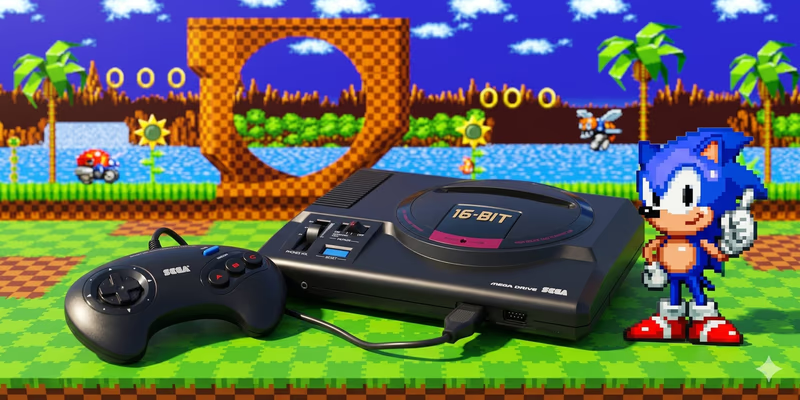
Nano Banana

An exhaustive historical and technical autopsy of the Sega Mega Drive (known as the Genesis in North America). We explore how Sega weaponized a legendary Motorola processor and an aggressive FM synthesizer to shatter Nintendo’s monopoly, forever changing the video game demographic from children to rebellious teenagers in the fiercest console war in history.
In the late 1980s, Nintendo possessed an iron-fisted monopoly over the video game industry. Their strict licensing agreements mathematically prevented Sega's 8-bit Master System from gaining any meaningful third-party developer support. Sega realized that fighting the Nintendo Entertainment System (NES) on its own terms was a losing battle; they needed to change the battlefield entirely.
Sega CEO Hayao Nakayama looked to the company's highly successful arcade division. His vision was bold: shrink the architecture of Sega's potent System 16 arcade board and put it in a sleek, black plastic shell for the living room. By launching the Mega Drive in Japan in 1988 (and North America in 1989), Sega strategically entered the 16-bit market a full two years before Nintendo's Super Famicom (SNES) would arrive. They weren't just releasing a new console; they were launching a preemptive strike.
To understand the attitude of the Mega Drive, you must look at its silicon. It was an incredibly fast, highly capable machine built from top-tier, off-the-shelf computer components.
Hardware is only as good as its marketing, and under the leadership of Tom Kalinske at Sega of America, the company launched the most aggressive advertising campaign the industry had ever seen.
The strategy was simple: position Nintendo as a child's toy and Sega as the cool, edgy alternative for teenagers. The famous "Sega does what Nintendon't" slogan became a cultural rallying cry.
As hardware analysts, we must address the legendary buzzword: "Blast Processing." Sega used this term in commercials to mock the slower speed of the SNES. Technically, "Blast Processing" was just a clever marketing spin on the console's Direct Memory Access (DMA) capabilities and a programming trick that allowed the video chip to update background colors at lightning speeds during the horizontal blanking interval. It wasn't a physical chip, but the illusion worked flawlessly. Sega weaponized the Motorola 68000's real speed to convince the world that the Mega Drive was an untouchable hot rod.
As the 16-bit era dragged on and the threat of 32-bit consoles loomed, Sega of Japan panicked. Instead of focusing solely on their true next-generation console (the Saturn), they attempted to artificially extend the life of the Mega Drive through expensive hardware add-ons.
Combining these peripherals created the infamous "Tower of Power." From an engineering perspective, it was a disaster. It required three separate massive AC power adapters plugged into the wall and created a convoluted, redundant architecture. This move fractured the user base, infuriated third-party developers who didn't know which hardware to program for, and severely damaged Sega's reputation heading into the next generation.
The Mega Drive's library perfectly reflected its edgy hardware and demographic shift.
Sega relentlessly iterated on the console's physical design throughout its lifecycle. The original Model 1 was large and featured a dedicated headphone jack with a physical volume slider. The Model 2 was a sleek, cost-reduced redesign that removed the headphone jack but refined the motherboard. Sega even pushed the boundaries of miniaturization with the Sega Nomad, a fully portable Mega Drive with a built-in color LCD screen.
By the end of its run, the Sega Mega Drive had sold nearly 31 million units worldwide.
Its legacy is unquestionable. It was the machine that shattered Nintendo’s 100% market monopoly, initiating the fiercest corporate rivalry in video game history. By combining blistering processing speed, raw FM synthesized audio, and an unapologetically rebellious attitude, the Mega Drive didn't just play games—it grew the industry up.

Affiliate link: Support the blog via Instant Gaming at no extra cost.
Sega Genesis / Mega Drive
Others Posts
An analytical autopsy of a machine that traveled from the future only to die too soon. We explore the brilliant, hyper-efficient engineering of the Sega Dreamcast.
We explore the towering ambition, the infamously complex dual-CPU architecture, and the legendary, arcade-perfect library.
A technical and historical breakdown of the Nintendo Wii U. We examine how its architectural bottlenecks, confusing marketing, and miraculous low-latency GamePad created a commercial failure that ultimately served as the essential prototype for Nintendo's modern hardware dominance.
We analyze the technological differences between LCD and OLED panels, redesigned acoustics, and connectivity to determine if the sensory upgrade justifies the generational leap.
A definitive technical clash between two titans of modern handheld gaming. We break down the closed-ecosystem optimization of Nintendo's ARM architecture against the raw x86 brute force of Valve's portable PC.

An analytical case study of the Nintendo Entertainment System. We explore how Nintendo merged highly efficient 8-bit silicon with aggressive hardware-based DRM (the 10NES chip) and ingenious industrial design

RoboCop: Rogue City: Teyon's faithful adaptation, Peter Weller's return, the sheer power of the Auto-9, and the gritty streets of Old Detroit.

Mutant Year Zero: Road to Eden: XCOM-style tactical combat, real-time stealth infiltration with Dux and Bormin, and the secrets of The Zone.
Conquer the toughest bosses in Minecraft Dungeons. Master attack patterns, exploit weak points, and equip the best builds for every major fight.
Are the Minecraft Dungeons DLCs worth buying? We break down all 6 expansions, their biomes, unique mechanics, boss fights, and rank the absolute must-haves.
games
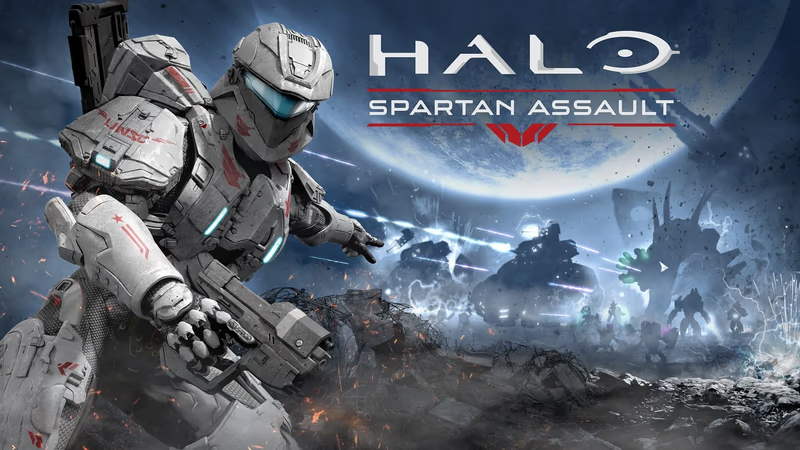
Halo: Spartan Assault: 343 Industries' jump into the twin-stick shooter genre, the battles of Sarah Palmer, and the heavy baggage of its mobile origins.