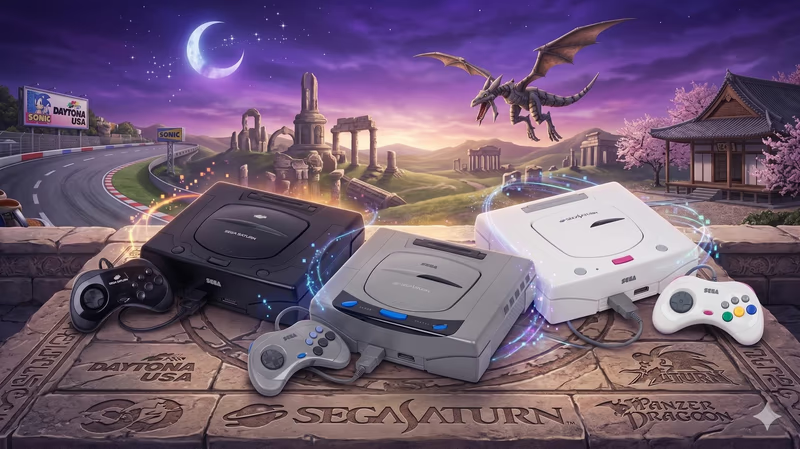
We explore the towering ambition, the infamously complex dual-CPU architecture, and the legendary, arcade-perfect library that cemented the Saturn not just as a casualty of the 90s console wars, but as a beloved, uncompromising masterpiece of gaming history.
The Prelude to 32-Bit: Background and Context
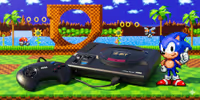
In the early 1990s, SEGA was on top of the world. The Sega Genesis (Mega Drive) had successfully challenged Nintendo's dominance in the West, propelled by aggressive marketing and the blazing speed of a blue hedgehog. Simultaneously, in the arcades, SEGA AM2 was rewriting the rules of gaming with groundbreaking 3D titles like Virtua Racing and Virtua Fighter running on their potent Model 1 and Model 2 arcade boards.
However, the industry was on the precipice of a seismic shift. The transition from 16-bit to 32-bit architecture, and more importantly, from 2D sprites to 3D polygons, was looming. SEGA needed a machine that could bring their cutting-edge arcade experiences into the living room while remaining the undisputed king of 2D gaming. The pressure was immense, compounded by whispers of a new, formidable challenger entering the arena: Sony, with its PlayStation.
Engineering a Powerhouse: The Development of the Saturn
The development of the Saturn (named after the sixth planet from the sun, as it was SEGA's sixth major home console) was a tale of brilliance mixed with internal friction. Designed primarily by Hideki Sato and his hardware team in Japan, the console was initially envisioned as the ultimate 2D gaming machine with capable 3D functions.
However, when SEGA got wind of the PlayStation's formidable 3D specifications, panic ensued. In a frantic bid to match Sony's polygon-pushing power, SEGA's engineers made a fateful decision: they bolted a second CPU onto the motherboard late in the design process. This resulted in an incredibly powerful machine, but one with an architecture so convoluted that it became a nightmare for third-party developers to program for. It was a console built by hardware engineers, for hardware engineers, lacking the streamlined software development kits (SDKs) that Sony provided.
The Launch: A Tale of Three Markets
The Saturn's introduction to the world remains one of the most studied case studies in marketing history.
- Japan (November 1994): The launch was a roaring success. Priced at 44,800 yen, the console sold a staggering 200,000 units on its first day, largely fueled by a nearly arcade-perfect port of Virtua Fighter. In its homeland, the Saturn went toe-to-toe with the PlayStation for years.
- North America (May 1995): The infamous E3 surprise. Originally slated for a "Saturnday" release in September, SEGA of America CEO Tom Kalinske was ordered by Japanese executives to launch the console immediately during the first-ever E3. Kalinske took the stage, announced a high $399 price tag, and declared the console was "available right now." This alienated major retailers (who were left out of the secret launch) and frustrated third-party developers whose games weren't ready. Sony's Steve Race famously followed up with a brief, devastating presentation, saying only "$299" before walking off stage.
- Europe (July 1995): Despite SEGA's historic dominance in the European market with the Master System and Mega Drive, the high price point and the early momentum of the PlayStation left the Saturn struggling to gain a foothold.
Under the Hood: Hardware and Technical Specifications
To understand the Saturn is to understand a beautifully complex orchestra of silicon. Instead of using triangles for 3D rendering like the rest of the industry, the Saturn rendered 3D using quadrilaterals (four-sided polygons), giving its games a unique, slightly warped visual signature.
- Processors: Two 32-bit Hitachi SH-2 RISC CPUs running at 28.6 MHz. Getting these two brains to work in parallel without bottlenecking each other was the ultimate test for programmers.
- Video Display Processors (VDP): * VDP1: Handled sprites, polygons, and geometry.
- VDP2: A specialized chip dedicated entirely to rendering scrolling backgrounds. It could handle infinite planes and scaling, making the Saturn a god-tier machine for 2D fighters and shooters.
- Audio: A custom Motorola 68EC000 sound processor paired with a magnificent Yamaha FH1 DSP. The Saturn's soundscape was rich, supporting up to 32 voices and CD-quality audio.
- Memory: 2MB of Work RAM, 1.5MB of VRAM, and a built-in cartridge slot. This slot would become legendary, supporting 1MB and 4MB RAM expansion cartridges that allowed arcade-perfect ports of heavy 2D games that the PlayStation simply could not run.
The Soul of the Machine: Iconic Video Games
While third-party support waned in the West, SEGA's internal studios produced some of the most innovative and purely joyful games of the generation.
- Nights into Dreams...: Yuji Naka's masterpiece. A fluid, mesmerizing flight action game that pioneered analog control with the bundled 3D Control Pad.
- Panzer Dragoon Saga: An RPG masterpiece spread across four discs. It featured a deep combat system and a breathtaking world, now standing as one of the rarest and most acclaimed games of the era.
- The Arcade Holy Trinity: Virtua Fighter 2, Sega Rally Championship, and Virtua Cop. SEGA AM2 achieved the impossible, squeezing arcade boards into a home console.
- The 2D Fighting Kings: Thanks to the RAM expansion cart, Capcom and SNK released flawless ports of X-Men vs. Street Fighter, Street Fighter Alpha 3, and Marvel Super Heroes.
- Radiant Silvergun: Treasure's magnum opus, a vertical shoot-'em-up that pushed the hardware to its absolute limit, remaining a legendary exclusive.
The Commercial Reality: Sales Throughout Its Life
Despite its passionate fanbase, the Saturn's commercial life was an uphill battle. While it fought valiantly in Japan—even outselling the Nintendo 64 there—its high manufacturing costs (due to the multitude of chips on the motherboard) meant SEGA lost money on hardware sales for a long time.
The lack of a mainline, traditional Sonic the Hedgehog game (following the tragic cancellation of Sonic X-treme) left the console without a much-needed mascot title to push Western sales. Ultimately, the Saturn sold approximately 9.26 million units worldwide—a respectable number, but far behind the PlayStation's staggering 102 million.
The Sun Sets: Discontinuation
By 1998, the financial strain was too great. SEGA formally discontinued the Saturn in North America and Europe to focus its remaining resources on the development of its final swan song, the Dreamcast. The console lived on until 2000 in Japan, supported by a steady stream of visual novels and niche arcade ports.
The Sega Saturn may have lost the 32-bit war, but it never compromised its soul. It was a console that demanded mastery from its developers and rewarded its players with unadulterated, arcade-pure magic. Today, it stands not as a failure, but as a misunderstood titan of hardware engineering—a beautiful, complicated love letter to a bygone era of gaming.