We explore how Nintendo dominated the 16-bit console war not through sheer CPU speed, but through a masterful integration of custom audio-visual processors, revolutionary controller ergonomics, and an ingenious strategy of in-cartridge hardware expansion.
History
In the late 1980s, Nintendo enjoyed a virtually unchallenged global monopoly with the 8-bit Nintendo Entertainment System (NES). This massive market dominance bred corporate complacency. Even as competitors like NEC (PC Engine) and Sega (Mega Drive) launched technologically superior 16-bit systems, Nintendo initially ignored the threat, reluctant to cannibalize their highly profitable 8-bit hardware sales.
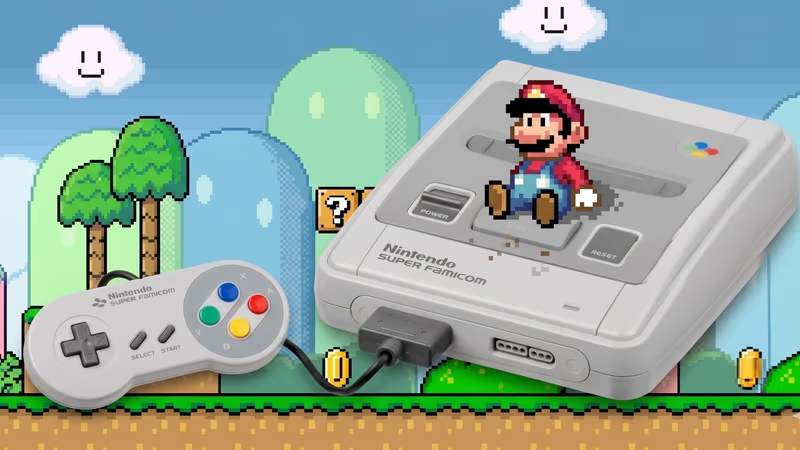
However, as Sega began aggressively capturing market share in the West, Kyoto was forced to respond. Led by hardware engineer Masayuki Uemura, the "Super Famicom" project was initiated. Uemura’s engineering philosophy was distinctly different from Sega’s. The goal was not to build a machine with the fastest raw processing speed, but rather to engineer a perfectly balanced audiovisual canvas that gave software developers unprecedented tools to manipulate color, sound, and background layers.
Hardware Architecture
From a silicon perspective, the SNES is a fascinating study in prioritizing custom graphical subsystems over central processing muscle.
- The Achilles Heel (The Ricoh 5A22 CPU): The central processor was the system's most notable bottleneck. Based on the 16-bit 65C816 architecture, the custom Ricoh 5A22 CPU was clocked at a maximum of just 3.58 MHz. In a direct mathematical comparison, it was significantly slower than the Mega Drive’s 7.6 MHz Motorola 68000. This architectural deficit was the direct cause of the infamous hardware "slowdowns" in early SNES titles when the screen was overloaded with active sprites.
- The Visual Magic (The PPUs): To compensate for the slow CPU, Nintendo integrated two dedicated Picture Processing Units (PPU1 and PPU2). These chips were graphical powerhouses, capable of outputting a massive palette of 32,768 colors (with 256 on-screen simultaneously) and natively processing hardware-level transparencies and color math. The true crown jewel of the PPUs was Mode 7, a mathematical rendering mode capable of scaling and rotating a 2D background layer using affine transformations. This allowed developers to simulate dynamic 3D environments, serving as the foundational technology for titles like F-Zero and Super Mario Kart.
- Sony's Trojan Horse (The SPC700): The audio architecture of the SNES remains one of the most legendary hardware inclusions in gaming history. Designed secretly by Sony engineer Ken Kutaragi (who would later create the PlayStation), the SPC700 was an 8-channel audio co-processor paired with its own 64 KB of dedicated SRAM. Unlike the harsh, synthesized FM audio of its competitors, the SPC700 utilized ADPCM (Adaptive Differential Pulse-Code Modulation) digital samples. It effectively acted as a high-end wavetable synthesizer, allowing the console to replicate actual acoustic instruments and full symphonic orchestrations.
The Expandable Hardware Strategy
Nintendo's most brilliant engineering strategy was standardizing a flexible cartridge architecture. Recognizing the inherent limitations of the 3.58 MHz CPU, the motherboard was designed to interface seamlessly with external math coprocessors embedded directly onto the game cartridges.
- The DSP (Digital Signal Processor): Early in the console's lifecycle, games like Pilotwings and Super Mario Kart utilized the DSP-1 chip to rapidly calculate the complex trigonometry required for advanced Mode 7 scaling and 3D track rotation without stalling the main CPU.
- The Super FX Chip: Developed by Argonaut Software, this was a custom RISC processor placed inside the cartridge. Clocked at 10.4 MHz (and later 21.4 MHz in the Super FX GSU-2), this chip allowed the 2D console to calculate and render true, flat-shaded 3D polygons in real-time, bringing titles like Star Fox to life.
- The SA-1 Chip: Used late in the console's life for games like Super Mario RPG, the SA-1 acted as a secondary 65C816 CPU clocked at a blistering 10.74 MHz. It vastly accelerated processing speeds, data compression, and memory mapping, pushing the 16-bit console well beyond its original factory specifications.
The Controller
While the internal silicon was highly advanced, the external human interface design was revolutionary. The SNES controller established the ergonomic blueprint that every modern console manufacturer still utilizes today.
Nintendo introduced the diamond layout for the face buttons (A, B, X, Y), providing intuitive thumb access to complex input combinations. Most importantly, Nintendo invented the shoulder buttons (L and R). By placing inputs on the top edge of the controller, players could utilize their index fingers, effectively uncoupling camera control or secondary actions from the primary thumb inputs. It was a masterclass in industrial design that forever changed how software could be coded and played.
The Games
The SNES software library is objectively considered one of the strongest in the medium's history, directly benefiting from the hardware's audiovisual strengths.
- JRPG Dominance: The massive color palette and orchestral capabilities of the SPC700 made the SNES the definitive home for Japanese Role-Playing Games. Developers like Squaresoft and Enix leveraged the hardware to produce sprawling, cinematic epics like Final Fantasy VI and Chrono Trigger.
- Strategic Exclusivities: Nintendo delivered a fatal blow to its competitors by securing the early console exclusivity of Capcom’s Street Fighter II, the biggest arcade hit of the decade. Simultaneously, internal teams pushed the boundaries of level design with Super Mario World and Super Metroid.
- Rareware's Miracle: In 1994, as 32-bit CD-ROM consoles loomed on the horizon, developer Rareware released Donkey Kong Country. By using multi-million-dollar Silicon Graphics workstations to pre-render 3D models and compress them into 16-bit 2D sprites, they achieved a visual fidelity that completely neutralized the immediate graphical threat of next-generation hardware.
Sales, Commercial Victory, and Legacy
Despite its delayed entry into the market and enduring one of the most aggressive corporate marketing assaults in history from Sega of America, the SNES ultimately emerged victorious. The hardware sold over 49.1 million units worldwide, securing Nintendo's position as the undisputed market leader of the 16-bit generation.
The legacy of the Super Nintendo is pristine. While the early 3D polygons of the subsequent 32-bit era aged poorly, the expertly crafted 16-bit sprite art of the SNES remains timeless. Through a combination of expandable architecture, peerless audio, and revolutionary ergonomics, the SNES stands today as a perfectly optimized machine and the absolute pinnacle of 2D hardware engineering.