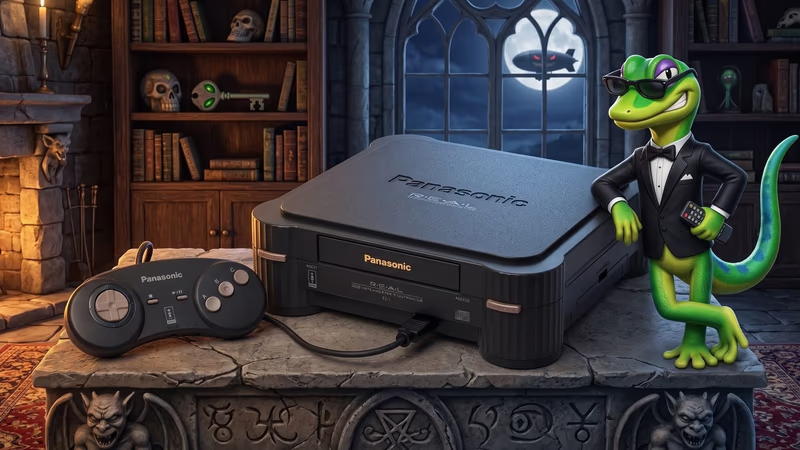
We examine the cutting-edge implementation of early ARM architecture, the fragmented hardware manufacturing ecosystem, and the fundamental economic flaw in its licensing model that doomed a powerful 32-bit standard to commercial failure.
History
To analyze the 3DO Interactive Multiplayer, one must fundamentally shift how they view console hardware. The 3DO was not a standalone console manufactured by a single gaming company; it was a hardware and software standard.
In 1991, Electronic Arts founder Trip Hawkins left the company to establish The 3DO Company. His vision was to replicate the business model of the VCR. The 3DO Company would not manufacture physical hardware. Instead, they engineered a highly advanced set of hardware specifications and licensed the blueprints to global consumer electronics giants. The goal was to establish a universal, unified standard for living room entertainment—a "multimedia" hub capable of playing high-end video games, educational software (edutainment), and interactive movies on CD-ROM.
Hardware Architecture: The 32-Bit Vanguard and the Arrival of ARM
Released in late 1993, the 3DO specification was an undeniable technological leap over the dominant 16-bit systems (the SNES and Sega Mega Drive), bringing workstation-level concepts to the consumer market.
- The CPU (ARM60): The system was powered by a 32-bit RISC ARM60 processor clocked at 12.5 MHz. This is a critical historical and technical milestone. The 3DO was one of the earliest high-profile consumer devices to utilize Advanced RISC Machines (ARM) architecture. Its high instruction-per-clock efficiency laid the groundwork for the architecture that entirely dominates modern mobile computing today.
- The Custom Co-processors: The true graphical muscle of the 3DO lay in its two custom video co-processors, clocked at 25 MHz. These chips were capable of rendering up to 30,000 fully textured, Gouraud-shaded polygons per second, alongside advanced math calculations and hardware sprite scaling. It allowed for fluid 3D environments and complex 2D scaling that legacy consoles simply could not calculate.
- Peripheral Daisy-Chaining: In a highly unusual engineering decision, the 3DO console featured only one controller port on its chassis. To facilitate local multiplayer, the controllers themselves contained a pass-through port. Players had to plug the second controller directly into the back of the first, creating a "daisy-chain" that mathematically supported up to eight simultaneous players, albeit creating a tangled physical mess in the living room.
The Manufacturers: Panasonic, GoldStar, and Sanyo
Because 3DO was a licensed standard, the physical implementation varied wildly depending on the electronics manufacturer, even though the internal silicon remained strictly standardized.
- Panasonic FZ-1: The premier launch unit. It was designed to look like high-end audio-visual equipment, featuring a front-loading motorized CD tray and a heavy, durable chassis. It visually communicated the system's "premium multimedia" marketing angle.
- GoldStar 3DO (GDO series): Entering the market slightly later, South Korean manufacturer GoldStar (now LG) released a lighter, cheaper model to target a more budget-conscious demographic, though the price remained relatively high.
- Sanyo TRY: Released exclusively in Japan, Sanyo’s implementation featured a completely different, somewhat more toy-like aesthetic, proving that the standard could be housed in virtually any form factor the manufacturer desired.
Analysis of the Business Model
The 3DO failed not because of its silicon, but due to a catastrophic miscalculation in its economic structure.
In the traditional video game business model, companies like Nintendo and Sega utilized a "loss-leader" strategy. They sold the console hardware at a loss to quickly build a massive user base, making their profits by charging developers hefty licensing fees to publish game cartridges.
Hawkins inverted this model to aggressively court third-party developers. The 3DO Company charged an unprecedented, rock-bottom royalty rate of just $3 per disc manufactured. However, because hardware manufacturers like Panasonic and GoldStar were not receiving any of this software royalty revenue, they could not afford to sell the hardware at a loss. They had to extract their entire profit margin directly from the retail price of the physical machine.
Consequently, the Panasonic FZ-1 launched in the United States at $699 (equivalent to over $1,400 adjusted for inflation). In an era where competing consoles sold for $199, this price tag created an insurmountable barrier to entry, starving the ecosystem of the user base required to sustain it.
Games: The FMV Boom and the Origins of Modern Franchises
Despite the low install base, the 3DO library was an fascinating mix of cutting-edge technology and multimedia experimentation.
- The FMV Era: Utilizing the system's double-speed CD-ROM drive and dedicated video decoding hardware, the 3DO became a haven for Full Motion Video (FMV) games. Titles like Crash 'n Burn and the controversial Night Trap relied heavily on digitized video sequences, representing the peak of the 90s multimedia craze.
- Arcade Perfection: When software utilized the ARM60 and custom co-processors rather than video files, the results were stellar. The 3DO hosted the absolute definitive home port of Super Street Fighter II Turbo, featuring CD-quality orchestrated audio and flawless arcade speed.
- Birth of Modern Franchises: The low developer royalties attracted Electronic Arts and Crystal Dynamics. The system birthed the platforming mascot Gex, and more significantly, served as the exclusive launch platform for a groundbreaking 3D driving simulator titled The Need for Speed.
Market Collapse and the End of the Standard
The 3DO standard's fragile existence was violently shattered in 1995 with the global rollout of the Sega Saturn and the Sony PlayStation.
Sony’s PlayStation launched at $299. It featured dedicated 3D geometry hardware that vastly outperformed the 3DO, and Sony possessed the corporate capital to sell the hardware at a loss. Overnight, the $699 3DO standard was rendered both technologically and economically obsolete.
The 3DO Company attempted to pivot by engineering a vastly more powerful 64-bit successor known as the M2. However, realizing the hardware market was now locked in a brutal duopoly between Sony and Nintendo, Hawkins abandoned the hardware business entirely. The M2 technology was sold to Matsushita (Panasonic) for industrial use, and The 3DO Company transitioned strictly into a third-party software publisher, operating until its eventual bankruptcy in 2003.
The 3DO Interactive Multiplayer remains a pristine example of hardware innovation crushed by market realities—a visionary standard that correctly predicted the CD-ROM future but failed to understand the brutal economics of living room hardware.