Nintendo Switch OLED Review
We explore how the Switch OLED prioritizes sensory refinement over brute force, pairing a stunning, high-contrast display and superior engineering with one of the greatest software libraries in gaming history.
Nano Banana

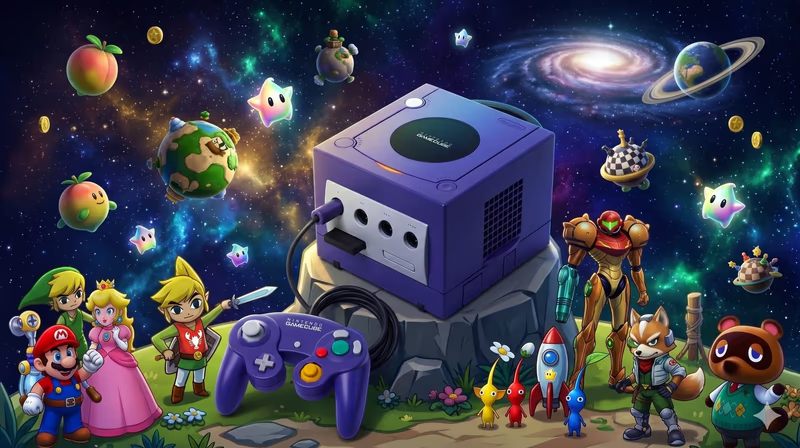
We explore the Nintendo GameCube's surprisingly muscular architecture, its quirky, toy-like design, and the brutal market realities it faced against the DVD-playing juggernauts of its era. It is a story of engineering elegance overshadowed by shifting industry trends, resulting in a console that is revered today as a cult masterpiece.
To understand the genesis of the GameCube, we must look at the costly mistake of its predecessor. The Nintendo 64 was a 3D pioneer, but Nintendo’s stubborn adherence to the ROM cartridge alienated third-party developers like Square Enix, who fled to Sony’s original PlayStation for the vast storage of CD-ROMs. Nintendo had learned its lesson.
Initiated in the late 1990s under the codename "Project Dolphin," Nintendo’s mandate for their sixth-generation console was clear: it had to be developer-friendly, and it had to use optical media. To achieve this, Nintendo formed a dream team of hardware partners. They tapped IBM to design a custom processor and joined forces with a brilliant group of former SGI engineers at ArtX (a company later acquired by ATI) to build the graphics pipeline. To solve the optical drive dilemma without handing over technology rights to a competitor, Nintendo partnered with Matsushita (Panasonic) to create a proprietary disc format. The goal was no longer just raw polygon pushing, but creating a balanced, highly efficient development environment.
We look back at the GameCube's motherboard with immense respect. While the original Xbox was a brute-force PC in a box and the PlayStation 2 relied on the notoriously difficult-to-program Emotion Engine, the GameCube was a masterclass in architectural elegance.
Nintendo’s approach to the physical hardware resulted in one of the most distinctive chassis in gaming history: a literal cube with a carrying handle.
Upon its release in late 2001, the GameCube was met with a polarized reception.
Critics praised the system’s robust performance, negligible load times, and the immediate influx of top-tier software. Games like Metroid Prime and Resident Evil 4 pushed visual boundaries that left reviewers stunned, proving the little purple box was a graphical powerhouse.
However, user reception was a mixed bag. The console's toy-like aesthetic, coupled with the controversial reveal of The Legend of Zelda: The Wind Waker (which abandoned realistic graphics for cel-shaded animation), unfairly branded the GameCube as a "kiddy" console in the West. Furthermore, mainstream consumers were frustrated by the lack of DVD movie playback—a feature that was actively driving the explosive sales of the PlayStation 2 in living rooms around the world.
In the context of the sixth console generation, the GameCube was a commercial disappointment for Nintendo. It sold a total of 21.74 million units worldwide.
It lost the console war spectacularly to the PlayStation 2 (over 155 million units) and was narrowly edged out of second place by Microsoft's newcomer, the Xbox (24 million units). Its market share shrank significantly compared to the N64 era. Yet, from a purely corporate standpoint, Nintendo maintained its famously tight margins; unlike Microsoft, which bled billions of dollars establishing the Xbox brand, Nintendo sold the GameCube hardware at a profit, ensuring the company remained financially healthy.
Time has been incredibly kind to the Nintendo GameCube. What was once dismissed as a purple lunchbox is now revered as one of the greatest pure gaming consoles ever manufactured.
From a hardware lineage perspective, its architecture was so efficient and perfectly balanced that Nintendo literally recycled the Gekko/Flipper foundation for their next two consoles: the Wii and the Wii U. On the software side, its library is devoid of filler, boasting titles that remain timeless masterpieces of game design. Furthermore, the GameCube controller has achieved a mythical status; over two decades later, Nintendo still manufactures adapters and modern versions of the controller specifically because the competitive Super Smash Bros. community refuses to play with anything else.
The GameCube didn't win the sales war, but it earned something far more enduring: unquestionable hardware respect and permanent cultural immortality.

Affiliate link: Support the blog via Instant Gaming at no extra cost.
Nintendo GameCube
Others Posts
We explore how the Switch OLED prioritizes sensory refinement over brute force, pairing a stunning, high-contrast display and superior engineering with one of the greatest software libraries in gaming history.
We explore the towering ambition, the infamously complex dual-CPU architecture, and the legendary, arcade-perfect library.
We explore how a modified PC architecture, the inclusion of a standard hard drive, and the pioneering of broadband multiplayer disrupted the sixth generation of consoles, securing Microsoft's place in the living room and altering the industry's trajectory forever.

We explore how Nintendo traded teraflops for accessibility, turning a glorified remote control into a global cultural phenomenon that brought gaming to living rooms, retirement homes, and the masses.
A technical breakdown of the PlayStation 3's engineering and market performance. We examine the notoriously complex Cell Broadband Engine, the split-memory bottleneck.

We explore how SNK defied market logic by packaging exact arcade hardware for the living room, creating a brutally powerful, absurdly expensive 16-bit console that became the ultimate status symbol and reigned supreme for an astonishing 14 years.

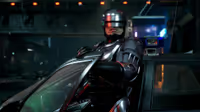
RoboCop: Rogue City: Teyon's faithful adaptation, Peter Weller's return, the sheer power of the Auto-9, and the gritty streets of Old Detroit.

Mutant Year Zero: Road to Eden: XCOM-style tactical combat, real-time stealth infiltration with Dux and Bormin, and the secrets of The Zone.
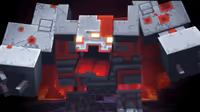
Conquer the toughest bosses in Minecraft Dungeons. Master attack patterns, exploit weak points, and equip the best builds for every major fight.
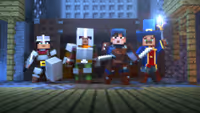
Are the Minecraft Dungeons DLCs worth buying? We break down all 6 expansions, their biomes, unique mechanics, boss fights, and rank the absolute must-haves.
games
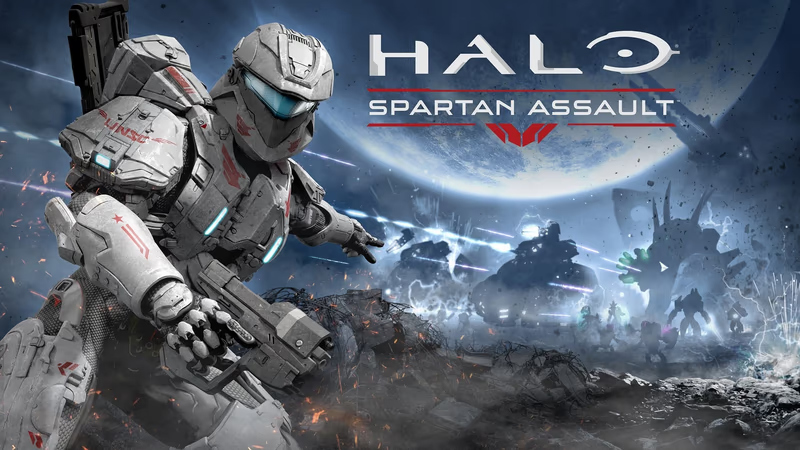
Halo: Spartan Assault: 343 Industries' jump into the twin-stick shooter genre, the battles of Sarah Palmer, and the heavy baggage of its mobile origins.