Halo Combat Evolved Review
Before Halo CE, console FPS games were a clunky joke. Discover how Bungie's golden triangle of combat and AI rewrote the rulebook forever.

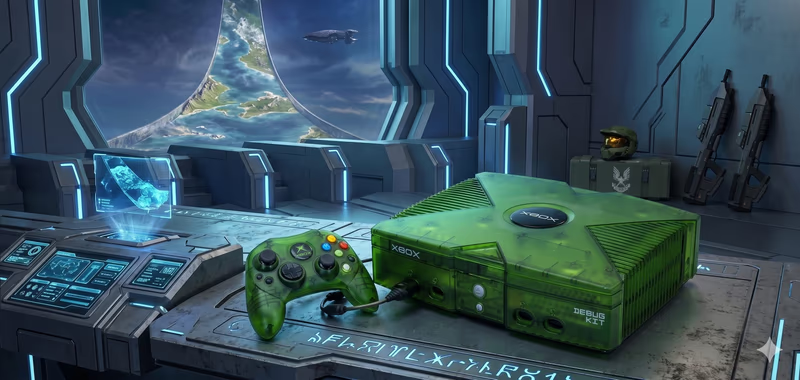
Nano Banana Pro

We explore how a modified PC architecture, the inclusion of a standard hard drive, and the pioneering of broadband multiplayer disrupted the sixth generation of consoles, securing Microsoft's place in the living room and altering the industry's trajectory forever.
To understand the inception of the original Xbox, we must first look at the turn-of-the-millennium anxieties within the halls of Redmond, Washington. Microsoft was the undisputed king of desktop computing, but a new threat was looming: Sony’s PlayStation 2. Marketed as a "Trojan Horse" that could play DVDs and connect to the internet, Bill Gates and Microsoft executives feared the PS2 would eventually replace the Windows PC as the central hub of home entertainment.
In response, a rogue team of engineers from Microsoft's DirectX graphics API group—including Seamus Blackley and Kevin Bachus—proposed a radical counter-offensive. They pitched the "DirectX Box," a dedicated gaming console built entirely from standard, easily programmable PC components. It was a massive cultural clash for a company strictly focused on software, but the fear of losing the living room pushed Bill Gates to greenlight the project. Microsoft was not entering the console war to make a quick profit; they were entering it for strategic survival.
When the Xbox launched in November 2001, it was an absolute powerhouse. As hardware analysts, looking inside the chassis of the original Xbox is like opening a time capsule of early 2000s PC technology. While the PS2 and GameCube relied on highly specialized, proprietary custom silicon, Microsoft took a completely different, brute-force approach.
Raw power means nothing without software, and Microsoft needed a killer app to justify the machine's existence.
Upon its release, the critical reception of the hardware was overwhelmingly positive. Reviewers were stunned by the graphical fidelity of games like Halo and Dead or Alive 3. However, gamers and critics alike poked fun at the console's VCR-like bulk and the unwieldy launch controller.
Commercially, the Xbox achieved a respectable second place globally, selling over 24 million units. It successfully outpaced the Nintendo GameCube, but it was absolutely dwarfed by the unstoppable momentum of the PlayStation 2 (over 155 million units).
Financially, the original Xbox was a bloodbath for Microsoft. Because the company used expensive, off-the-shelf PC components (specifically the hard drive and Intel/Nvidia silicon), they sold every console at a steep loss. It is estimated that Microsoft lost over $4 billion on the Xbox project. However, from a corporate perspective, this was viewed as the necessary cost of buying a seat at the table and establishing a trusted brand.
The original Xbox's legacy is defined by two massive pillars: online gaming and architectural influence.
In 2002, Microsoft launched Xbox Live. Instead of the fragmented, developer-dependent online experiences of the past, Xbox Live offered a unified, premium ecosystem. It standardized universal friends lists, matchmaking, and, most importantly, mandatory voice chat via a headset. It transformed online console gaming from a niche hobby into a global social phenomenon.
Furthermore, the Xbox's hardware architecture predicted the future. Today, the PlayStation 5 and Xbox Series X are, essentially, highly customized x86 PCs with internal storage and broadband connections—the exact blueprint Microsoft drafted in 2001. Finally, we must acknowledge the legendary homebrew community; the machine's PC architecture and hard drive made it the ultimate playground for modders, famously giving birth to the Xbox Media Center (XBMC), which the world knows today as Kodi.
The original Xbox was bulky, expensive, and a financial black hole, but it boldly dragged the console industry kicking and screaming into the 21st century.

Affiliate link: Support the blog via Instant Gaming at no extra cost.
Xbox
Others Posts
Before Halo CE, console FPS games were a clunky joke. Discover how Bungie's golden triangle of combat and AI rewrote the rulebook forever.
We explore the towering ambition, the infamously complex dual-CPU architecture, and the legendary, arcade-perfect library.
We explore the Nintendo GameCube's surprisingly muscular architecture, its quirky, toy-like design, and the brutal market realities it faced against the DVD-playing juggernauts of its era.

We explore how SNK defied market logic by packaging exact arcade hardware for the living room, creating a brutally powerful, absurdly expensive 16-bit console that became the ultimate status symbol and reigned supreme for an astonishing 14 years.

We dissect the brilliant foresight of its unified shader architecture and digital ecosystem, while critically examining the catastrophic thermal engineering failure of the "Red Ring of Death."

We analyze Mark Cerny's butterfly GPU architecture, the implementation of hardware-level checkerboard rendering, and the engineering tricks used to deliver a 4K experience without fragmenting the generation.


RoboCop: Rogue City: Teyon's faithful adaptation, Peter Weller's return, the sheer power of the Auto-9, and the gritty streets of Old Detroit.

Mutant Year Zero: Road to Eden: XCOM-style tactical combat, real-time stealth infiltration with Dux and Bormin, and the secrets of The Zone.

Conquer the toughest bosses in Minecraft Dungeons. Master attack patterns, exploit weak points, and equip the best builds for every major fight.
Are the Minecraft Dungeons DLCs worth buying? We break down all 6 expansions, their biomes, unique mechanics, boss fights, and rank the absolute must-haves.
games
Halo: Spartan Assault: 343 Industries' jump into the twin-stick shooter genre, the battles of Sarah Palmer, and the heavy baggage of its mobile origins.