Battlefield 1: The Beauty of the Trenches
DICE’s brutal journey into the First World War remains an unparalleled atmospheric masterpiece in the first-person shooter genre.
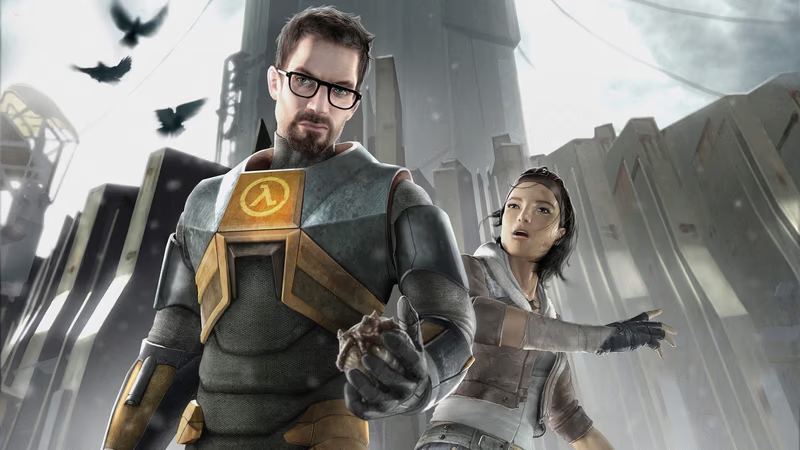
Image of Valve

If you were there in 2004, you remember the sheer magnitude of the moment. Half-Life 2 was not just a video game release; it was an industry-defining event. Following a tumultuous development cycle marked by astronomical hype, a devastating source code theft, and multiple delays, Valve finally unleashed Gordon Freeman’s second chapter. It also came tethered to a fledgling, highly controversial digital storefront called Steam—a move that fundamentally changed how PC games would be distributed forever.
When players finally booted it up, the collective gasp was palpable. Half-Life 2 did not simply iterate on its predecessor; it shattered the ceiling of what linear, narrative-driven first-person shooters could be, cementing its legacy as a cultural milestone that developers still study like a sacred text today.
"Wake up, Mr. Freeman. Wake up and smell the ashes." With those chilling words from the enigmatic G-Man, you are thrust not into a generic military base, but onto a sterile train arriving in City 17.
The atmosphere is instantly suffocating. Valve masterfully crafts a dystopian, Orwellian nightmare. Giant screens broadcast the pacifying propaganda of Dr. Wallace Breen, heavily armed Combine Civil Protection units beat citizens in the streets, and alien Stalkers roam the decaying architecture.
The true triumph of Half-Life 2’s narrative is how it is delivered. There are no pre-rendered cutscenes. The camera never leaves Gordon Freeman’s eyes, and you never lose control of your movement. The world happens around you, treating the player as an active participant rather than a passive viewer. You are not told that the Combine are an oppressive, multidimensional empire; you feel it when a guard knocks over a trash can and commands you to "pick up that can."
In 2004, the technical leap provided by Valve's proprietary Source Engine was staggering.
Valve’s understanding of pacing in Half-Life 2 is unparalleled. The game is a meticulously crafted rollercoaster that constantly introduces new mechanics, lets you play with them, and then seamlessly transitions to a new genre before you can ever feel bored.
You transition from the desperate, urban evasion of Route Kanal to the sheer survival horror of We Don't Go To Ravenholm... (a brilliant playground designed to teach you the lethal potential of the Gravity Gun). From there, you embark on a lonely, melancholic road trip along Highway 17, command antlion swarms in Nova Prospekt, and finally lead a full-scale urban guerrilla uprising in the streets of City 17. The game reinvents itself every couple of hours with flawless execution.
Pros:
Cons:
Half-Life 2 is not just a game you play for nostalgic value; it is a game you play because it is still, intrinsically, one of the greatest action titles ever crafted. Its pacing, its respect for the player's intelligence, and its atmosphere remain largely unsurpassed.
Yet, returning to City 17 always carries a bittersweet sting. The game, along with its subsequent expansion episodes, ends on one of the most agonizing cliffhangers in entertainment history. It is a tragedy of the medium that we may never know how Gordon Freeman’s story ends. But even with the eternal, lingering sorrow of Half-Life 3 remaining the industry's greatest myth, Half-Life 2 stands tall. It is a timeless masterpiece that every player, regardless of what generation they belong to, owes it to themselves to experience.
Affiliate link: Support the blog via Instant Gaming at no extra cost.
Half-Life 2
Others Posts
DICE’s brutal journey into the First World War remains an unparalleled atmospheric masterpiece in the first-person shooter genre.
Two decades after their release, the episodic additions to Half-Life 2 stand as some of Valve's finest work, showcasing brilliant cooperative AI and stunning environmental design—yet they remain forever haunted by a single, agonizing cliffhanger.
The first-person shooter genre where groundbreaking technology met massive-scale warfare, forever altering the multiplayer landscape.
Discover the core story without spoilers, the exact chronological order to play the franchise, and which modern platforms to find them on.

A definitive technical clash between two titans of modern handheld gaming. We break down the closed-ecosystem optimization of Nintendo's ARM architecture against the raw x86 brute force of Valve's portable PC.

Jason Brody's descent into hell, Vaas Montenegro's overwhelming charisma, and the formula that redefined Ubisoft forever.

Are the Minecraft Dungeons DLCs worth buying? We break down all 6 expansions, their biomes, unique mechanics, boss fights, and rank the absolute must-haves.

Master turn-based combat in Gears Tactics. Learn to chain executions for infinite Action Points, optimize class builds, and crush colossal bosses.

Analysis of the PlayStation 4 and PS4 Pro hardware. We examine the shared CPU bottleneck, the mirrored butterfly GPU design, memory optimizations, and the hardware-level checkerboard rendering that enabled the 4K transition.

PlayStation 5 Pro hardware: PSSR, Advanced Ray Tracing, and the AI Revolution. We analyze Sony's PlayStation Spectral Super Resolution (PSSR), RDNA 4 Ray Tracing advancements, and the engineering behind the end of the Fidelity vs. Performance compromise.
guides
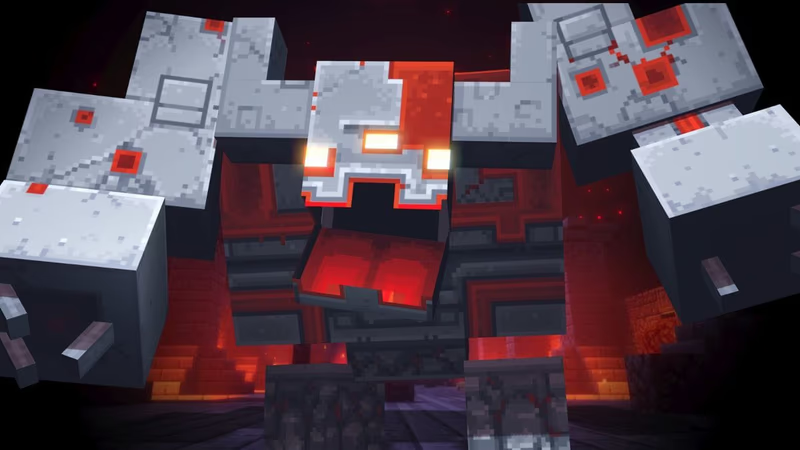
Conquer the toughest bosses in Minecraft Dungeons. Master attack patterns, exploit weak points, and equip the best builds for every major fight.