Ghost Recon Advanced Warfighter Review
The Tactical Revolution of a Generation - Ghost Recon Advanced Warfighter (GRAW): Ubisoft's groundbreaking tactical shooter, the Cross-Com system, and the birth of the Future Soldier in Mexico City.

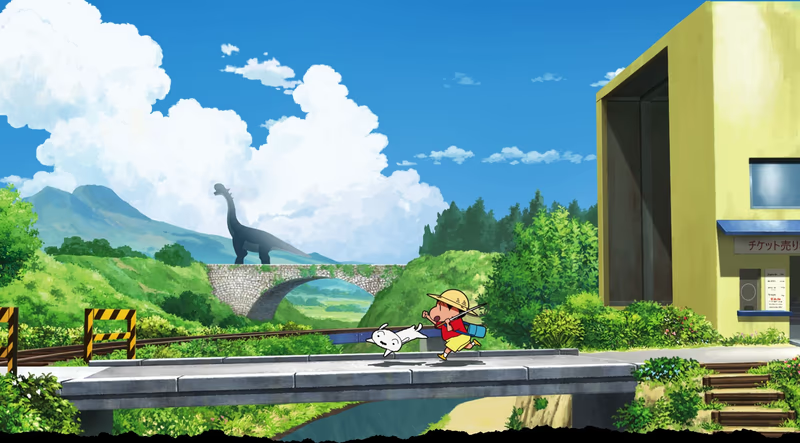
Image captured on Switch 2
Video games often task us with saving the galaxy, surviving the apocalypse, or climbing grueling competitive ladders. But every once in a while, a game asks you to do something radically different: absolutely nothing. Shin Chan: Me and the Professor on Summer Vacation - The Endless Seven-Day Journey is exactly that kind of game. Designed by Kaz Ayabe—the mastermind behind the legendary, Japan-exclusive Boku no Natsuyasumi (My Summer Vacation) series—this title is a digital holiday. Yet, what makes this rural getaway truly special is how flawlessly it injects the unapologetic, bizarre, and hilarious spirit of the Crayon Shin-chan anime into a serene virtual world.
The setup feels like a classic plot straight out of one of the animated Shin Chan theatrical movies. To coincide with a business trip for his father, Hiroshi, the Nohara family decides to spend a week in the sleepy, rural town of Asso (inspired by real-world Kumamoto).
At the train station, Shinnosuke runs into an eccentric, self-proclaimed "mad scientist" who gifts him a magical camera that illustrates his memories. What starts as a standard countryside vacation quickly goes off the rails. The professor summons actual dinosaurs to wander the town, and eventually traps Shin-chan in a time loop where his seven-day vacation repeats endlessly. It is a wildly absurd premise, but in the universe of Shin Chan, a five-year-old casually hanging out with a Brachiosaurus makes perfect, undeniable sense.
If you approach this game expecting a traditional adventure or an action RPG, you will be deeply confused. This is an iyashikei (healing) game. Your goal is simply to be a kid on summer break.
Every morning starts with radio calisthenics and a family breakfast. From there, you are free to explore. You run around with a butterfly net catching rare insects, fish in the local streams, water the vegetable garden, run errands for the local restaurant, and even act as a DJ at a café.
Everything you do is recorded in Shin-chan's Summer Diary, which you then submit to the local newspaper. Writing good articles earns you pocket money and, more importantly for Shinnosuke, scores him a "date" with the beautiful college student who runs the paper. There is absolutely no stress. There are no health bars, no enemies to defeat, and no "Game Over." If it gets too late, Hiroshi simply shows up, picks you up, and takes you home for dinner and a bath.
Visually, the game is a breathtaking contrast. The environments are highly detailed, pre-rendered, hand-painted backgrounds that look like they were pulled directly from a Studio Ghibli film. The lush greenery, the shimmering summer heat, the rusty train tracks, and the cozy wooden interiors are overwhelmingly beautiful.
Set against these static, painterly backgrounds are 3D cel-shaded character models. Miraculously, the two art styles blend perfectly. The atmosphere is further elevated by the masterful sound design: the gentle murmur of the river, the distant rumble of the local train, and the loud, nostalgic, and relentless chirping of Japanese cicadas.
This is where the game truly shines. A serene countryside game could easily become overly sentimental, but Shinnosuke Nohara refuses to let things get too quiet. The developers understood the assignment completely, perfectly capturing the essence and humor of Yoshito Usui’s original creation.
While the town is peaceful, Shin-chan is still his chaotic self. He hits on every beautiful older woman he meets using his classic, overly mature pick-up lines. He drives his mother, Misae, crazy with his sassy remarks. You can literally press a button to make him do his infamous "butt-alien" dance while running around town, much to the confusion of the locals. The game's localization is brilliant, adapting the anime's signature wordplay, physical comedy, and fourth-wall-breaking jokes flawlessly. It creates a perfect harmony: the environment relaxes you, but Shin-chan constantly makes you laugh.
Pros:
Cons:
Shin Chan: Me and the Professor on Summer Vacation is not for everyone, but for those willing to slow down, it is an absolute treasure. It succeeds because it taps into a universal longing: the memory of being a child, when summer felt endless, days were measured by the setting sun, and the biggest worry you had was catching a rare beetle. By blending this profound nostalgia with the hilarious, unapologetic comedy of one of anime's most iconic characters, the game delivers a uniquely comforting and deeply funny masterpiece.

Affiliate link: Support the blog via Instant Gaming at no extra cost.
Shin chan: Me and the Professor on Summer Vacation
Others Posts
The Tactical Revolution of a Generation - Ghost Recon Advanced Warfighter (GRAW): Ubisoft's groundbreaking tactical shooter, the Cross-Com system, and the birth of the Future Soldier in Mexico City.
A complete tactical guide to unlocking the ultimate Final Fantasy homage, surviving the hardest hidden boss in the game, and claiming the legendary Quartz Charm.

Gears Tactics: Splash Damage's aggressive turn-based adaptation of Gears of War, the execution mechanic, and the hunt for Ukkon.
Is Crysis just a hardware-melting benchmark or a genuine FPS masterpiece? We analyze CryEngine 2, Nanosuit mechanics, destructible physics, and the controversial Ceph shift.
The Order: 1886 transports us to a beautifully grim, smog-choked 19th-century London. But this is not the London of Charles Dickens; it's a battleground.
Master turn-based combat in Gears Tactics. Learn to chain executions for infinite Action Points, optimize class builds, and crush colossal bosses.
Are the Minecraft Dungeons DLCs worth buying? We break down all 6 expansions, their biomes, unique mechanics, boss fights, and rank the absolute must-haves.
Master turn-based combat in Gears Tactics. Learn to chain executions for infinite Action Points, optimize class builds, and crush colossal bosses.

Analysis of the PlayStation 4 and PS4 Pro hardware. We examine the shared CPU bottleneck, the mirrored butterfly GPU design, memory optimizations, and the hardware-level checkerboard rendering that enabled the 4K transition.

PlayStation 5 Pro hardware: PSSR, Advanced Ray Tracing, and the AI Revolution. We analyze Sony's PlayStation Spectral Super Resolution (PSSR), RDNA 4 Ray Tracing advancements, and the engineering behind the end of the Fidelity vs. Performance compromise.
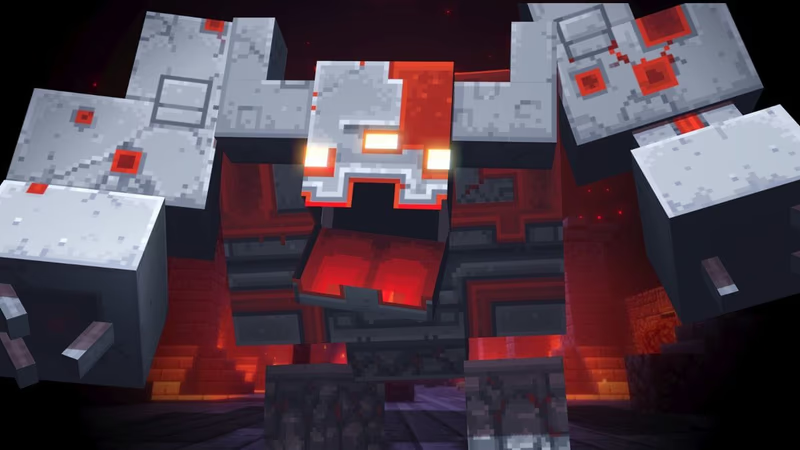
guides
Conquer the toughest bosses in Minecraft Dungeons. Master attack patterns, exploit weak points, and equip the best builds for every major fight.