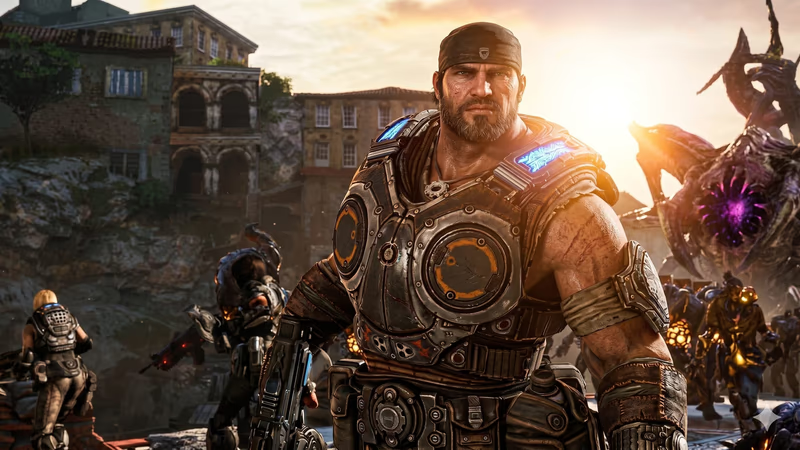
When Gears of War 3 launched in the autumn of 2011, it bore the unimaginable weight of expectations. It was not just the conclusion to a wildly successful trilogy; it was the final bow for Epic Games' original vision and the definitive swan song for the golden era of the Xbox 360. Set against the backdrop of a dying world, Gears of War 3 did the unthinkable for a franchise built on chainsaw bayonets and hyper-masculine bravado: it delivered a deeply human, tear-jerking finale that prioritized the bonds of brotherhood over the glory of victory.
The Last Sunrise on Sera: A World in Ruins
By the time the third chapter begins, the Coalition of Ordered Governments (COG) has completely collapsed. Humanity is no longer fighting a structured military war; they are a scattered band of nomadic survivors clinging to life aboard converted aircraft carriers and in fortified outposts. To make matters worse, the Locust Horde has been displaced by a terrifying mutual enemy: the Lambent, a highly mutated, explosive parasite born from the planet's Imulsion fuel.
The story is propelled by a singular, desperate glimmer of hope: Marcus Fenix discovers that his father, Adam Fenix, is still alive and claims to have a scientific solution to wipe out both the Locust and the Lambent. But the path to saving the world is paved with unimaginable personal tragedy.
The Devastating Climax of Dom and Marcus
While the search for Adam Fenix drives the plot, the true emotional core of Gears of War 3 is the heartbreaking resolution of Dominic Santiago and Marcus Fenix's brotherhood.
Following the traumatic events of the second game, Dom is a completely broken man. We find him emotionally hollowed out, tending to a small garden of radishes as a coping mechanism, fighting only out of loyalty to Marcus. Epic Games handled Dom’s depression with surprising nuance and respect. This culminates in what is undeniably the most iconic and devastating moment in the entire franchise. When Delta Squad is cornered and facing certain annihilation, Dom makes the ultimate sacrifice to ensure Marcus can finish the mission.
As a somber, instrumental piano version of Gary Jules' "Mad World" plays over the carnage, the game forces the player to witness the tragic, yet heroic, end of a beloved character. Seeing Marcus Fenix—the stoic, immovable rock of the franchise—completely break down as he tries to run into the flames to save his brother is a gut punch that elevated the narrative from a simple sci-fi shooter to a genuine tragedy.
A War for Four: Co-op and Gameplay Evolution
To match the epic scale of the finale, Epic Games expanded the campaign to support four-player cooperative play. This fundamentally changed the level design. The claustrophobic corridors of the past were replaced by wide, multi-tiered battlefields designed for actual squad-based flanking maneuvers. You were no longer just Marcus and Dom; you could fight alongside Cole, Baird, Anya Stroud, and Sam Byrne, making the war feel like a true group effort.
The arsenal also received its best update yet. Gears 3 introduced the Retro Lancer, a beautifully crude, high-recoil assault rifle with a bayonet that allowed you to charge and impale enemies. On the flip side was the Sawed-off Shotgun, a controversial but wildly fun weapon that offered one-hit obliteration at point-blank range. We even got to pilot the Silverback, a heavily armed, stomping mech-suit that turned the tide of massive firefights.
Stepping into the Sun: The Technical Leap
For years, the Gears franchise was teased for its "Destroyed Beauty" aesthetic, heavily reliant on gray, brown, and concrete palettes. Gears of War 3 shattered that reputation by pushing the Unreal Engine 3 to its absolute limit.
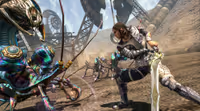
The game was bathed in vibrant colors. You fought under bright blue skies on tropical islands, fought through lush, overgrown green jungles, and battled in sun-drenched ruins. The Lambent enemies themselves were a visual spectacle, bursting in bright, golden-yellow explosions of Imulsion that illuminated the battlefields. It was a visual feast that proved the Xbox 360 still had immense graphical power left in reserve.
The Ultimate Multiplayer Package: Horde 2.0 and Beast Mode
Epic Games ensured that players would keep the disc in their consoles for years by offering arguably the most complete multiplayer suite of the generation.
- Horde 2.0: Epic took the mode they invented and perfected it. They added an in-game economy, allowing players to purchase and upgrade base defenses like barbed wire, automated turrets, decoys, and even Silverbacks, adding a brilliant layer of tower-defense strategy.
- Beast Mode: A stroke of genius where the roles were reversed. You played as the Locust Horde, earning currency to spawn as increasingly dangerous monsters—from explosive Tickers to the unstoppable Berserker—with a strict time limit to slaughter stranded human heroes.
- Dedicated Servers: Finally, the competitive Versus mode ran on dedicated servers. This eliminated the infamous "host advantage," offering a buttery smooth, 60 FPS competitive experience that perfected the Gnasher-focused meta.
Critical Acclaim, User Reception, and Xbox Legacy
Gears of War 3 was met with universal critical acclaim, boasting a Metacritic score in the low 90s. Critics praised it for successfully balancing its hyper-violent gameplay with genuine emotional weight, and for offering a multiplayer package that felt like three complete games in one.
For the fans, it was the definitive package. It gave them the closure they desperately wanted without feeling rushed or cheapened. For the Xbox 360, this game meant everything. Alongside Halo, Gears of War was the foundational pillar of the console's identity. Gears 3 proved that Microsoft's platform was the premier destination for mature, visually groundbreaking, and emotionally resonant blockbuster experiences. It was the system seller that justified the hardware.