Anthem: The Anatomy of a Failed Masterpiece
The universe of Anthem was rich with untapped potential, leaning heavily into a "science-fantasy" aesthetic.
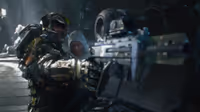
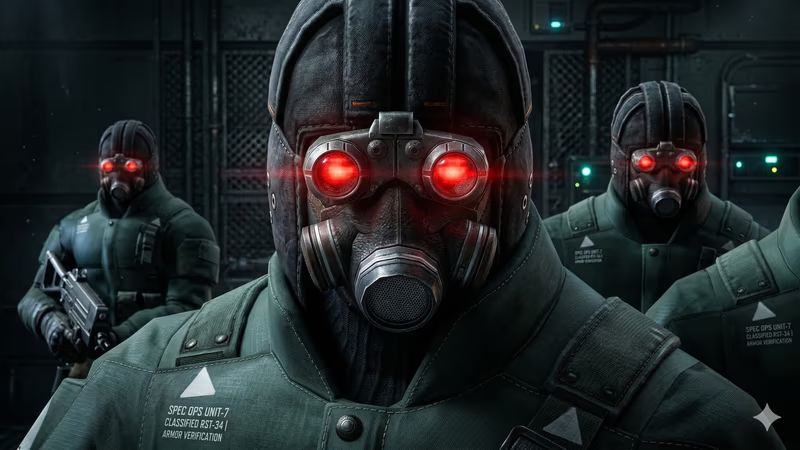
Image captured on Xbox Series X and retouched with Nano Banana.

Released in late 2006, Lost Planet: Extreme Condition was the vanguard of the high-definition era. In a time when the shooter genre was quickly becoming obsessed with gritty military realism and muddy brown color palettes, Capcom threw players into a blindingly white wasteland. It wasn't just another third-person shooter; it was a seamless blend of classic Japanese arcade design and massive Hollywood spectacle, proving exactly what the new generation of hardware was capable of.
The narrative premise is classic, high-stakes sci-fi. Earth has become uninhabitable, and humanity’s desperate bid for survival leads them to colonize E.D.N. III, a harsh planet locked in a perpetual ice age. However, humanity quickly discovers they are not the apex predators here. The planet is crawling with the Akrid, a vicious, highly adaptable race of insectoid aliens. The Akrid survive the extreme cold thanks to a biological quirk: Thermal Energy (T-ENG), a glowing orange fluid pumping through their bodies that quickly becomes the most valuable and contested resource in the universe.
Players step into the frostbitten boots of Wayne Holden, an amnesiac rescued by a ragtag group of Snow Pirates after his father is killed by a colossal Akrid known as the "Green Eye." Wayne finds himself thrust into a brutal three-way war. He must battle the endless Akrid swarms to survive, fend off rival pirate factions, and dismantle NEVEC (Neo-Venus Construction), a ruthless paramilitary corporation aiming to terraform the planet no matter the human cost.
What made Lost Planet truly revolutionary in 2006 was how it weaponized the cold. Your Thermal Energy gauge, ticking away in the corner of the screen, drains constantly due to the sub-zero environment. If it hits zero, your health starts rapidly bleeding away.
This mechanic completely flips traditional shooter design on its head. You cannot hide behind a rock and wait for your health to regenerate. The game forces you to become an aggressive predator. You must constantly push forward, slaughtering Akrid to harvest the glowing pools of T-ENG they leave behind. This ticking-clock survival loop is paired with a wrist-mounted grappling hook, giving Wayne unprecedented vertical mobility to escape ambushes or scale massive bosses to blast their weak points at point-blank range.
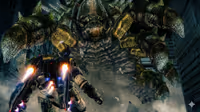
While the on-foot survival is thrilling, the inclusion of Vital Suits (VS) elevates the game to legendary status. Originally designed for construction and later weaponized to fight the largest Akrid, these mechs are a sci-fi fan's dream come true.
The game features agile bipedal walkers, hovercrafts, and heavy tanks. The transition between running on foot and piloting a massive VS is incredibly fluid, instantly shifting the scale of destruction. The most brilliant design choice? Wayne can physically rip the massive weapons off these mechs—like car-sized Gatling guns or heavy rocket launchers—and lug them around on foot, moving sluggishly but dealing devastating damage.
From a technical standpoint, Lost Planet was a breathtaking flex of Capcom’s legendary MT Framework engine. The art direction masterfully utilized visual contrast: the blinding white snow and cold, sterile NEVEC facilities clashed violently against the bright, fiery explosions and the neon orange T-ENG bleeding from the aliens.
The volumetric smoke, the motion blur during heavy firefights, and the way deep snow deformed around the heavy footsteps of the mechs were jaw-dropping in 2006. Sonically, the game is a triumph. The terrifying shriek of the Akrid, the heavy, metallic thud of a Vital Suit landing from a jump, and an epic orchestral score create an overwhelming sensory experience.
Pros:
Cons:
For Capcom, Lost Planet: Extreme Condition was a massive victory. It proved that a Japanese developer could dominate the early HD era and conquer the Western market without sacrificing its arcade roots. The community embraced it, turning it into a multi-million seller and launching a franchise that, while stumbling in its later sequels, started with an unstoppable momentum.
Is it worth playing today? Absolutely. Thanks to the magic of backward compatibility, playing it on current-generation hardware like the Xbox Series X/S is the definitive way to experience it. The modern hardware boosts the resolution and smooths out the framerate drops that plagued the original release, allowing the chaotic action to shine flawlessly. It is a perfect time capsule of 2000s gaming: no microtransactions, no endless RPG skill trees, and no filler—just pure, unapologetic, frozen adrenaline.

Affiliate link: Support the blog via Instant Gaming at no extra cost.
Lost Planet: Extreme Condition
Others Posts
The universe of Anthem was rich with untapped potential, leaning heavily into a "science-fantasy" aesthetic.
DICE’s brutal journey into the First World War remains an unparalleled atmospheric masterpiece in the first-person shooter genre.

Jason Brody's descent into hell, Vaas Montenegro's overwhelming charisma, and the formula that redefined Ubisoft forever.

The first-person shooter genre where groundbreaking technology met massive-scale warfare, forever altering the multiplayer landscape.
How to Master Combat, Weapons, and the Secrets of Alan Wake Remastered. Golden Rule: Light is your shield, and bullets are your sword.
A definitive tactical breakdown to shattering colossal Akrid and scrapping NEVEC’s deadliest Vital Suits.
Are the Minecraft Dungeons DLCs worth buying? We break down all 6 expansions, their biomes, unique mechanics, boss fights, and rank the absolute must-haves.

Master turn-based combat in Gears Tactics. Learn to chain executions for infinite Action Points, optimize class builds, and crush colossal bosses.

Analysis of the PlayStation 4 and PS4 Pro hardware. We examine the shared CPU bottleneck, the mirrored butterfly GPU design, memory optimizations, and the hardware-level checkerboard rendering that enabled the 4K transition.

PlayStation 5 Pro hardware: PSSR, Advanced Ray Tracing, and the AI Revolution. We analyze Sony's PlayStation Spectral Super Resolution (PSSR), RDNA 4 Ray Tracing advancements, and the engineering behind the end of the Fidelity vs. Performance compromise.
guides
Conquer the toughest bosses in Minecraft Dungeons. Master attack patterns, exploit weak points, and equip the best builds for every major fight.