Locating the Best Weapons in Super Mario RPG
Here is the step-by-step field guide to acquiring the ultimate main-game weapons for Princess Peach, Geno, Mallow, and Bowser, including their stats and what they bring to the battlefield.

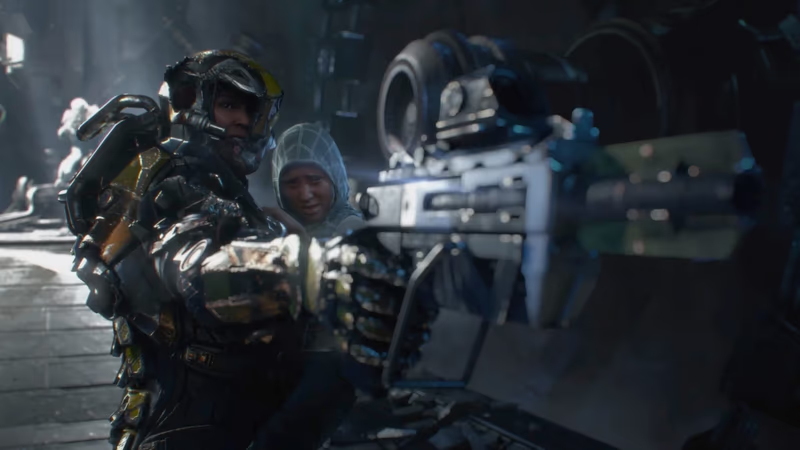
Image captured on PS4 Pro

When analyzing the modern video game industry, few titles serve as a more poignant cautionary tale than Anthem. Released in 2019, the game was supposed to represent a paradigm shift for its developer and publisher. Instead, it became a textbook example of how a game with a genuinely compelling narrative foundation and world-building can completely collapse under the weight of poor project management, technical hurdles, and a profound misunderstanding of the live-service genre.
At its core, the universe of Anthem was rich with untapped potential, leaning heavily into a "science-fantasy" aesthetic. The game is set on a volatile, unfinished world abandoned by its creators, god-like beings known as the Shapers. These Shapers left behind gigantic, world-altering terraforming machines that are powered by the "Anthem of Creation," a mysterious and highly unstable source of pure energy.
When these relics malfunction, they cause catastrophic events known as Cataclysms, mutating wildlife and altering the very fabric of reality. To survive this harsh environment, humanity lives in fortified settlements and relies on the Freelancers—brave pilots who operate advanced, heavily armed exosuits known as Javelins. The lore provided a perfect canvas for a constantly evolving live-service game, offering endless narrative justifications for new environments, monsters, and world events.
To understand the gravity of Anthem's failure, one must understand the expectations placed upon the studio. BioWare was an undisputed titan of the RPG genre, revered for the Mass Effect and Dragon Age franchises. Anthem was their ambitious foray into the lucrative "looter-shooter" market, heavily positioned by publisher Electronic Arts to be a direct competitor to Bungie's Destiny.
Internally, the project was codenamed "Dylan." BioWare’s leadership believed they were creating the Bob Dylan of video games—a title so revolutionary and culturally significant that it would be referenced by other developers for years to come. The expectation was nothing short of a ten-year franchise that would define the next generation of online multiplayer gaming.
Behind the scenes, Anthem suffered one of the most notoriously troubled development cycles in recent history. Despite being in development for nearly seven years, the game spent the vast majority of that time in a directionless pre-production phase. Leadership could not decide on the core identity of the game: was it a multiplayer shooter, a traditional BioWare RPG, or a survival game?
This indecision was compounded by a dangerous studio culture reliant on "BioWare Magic"—a belief that no matter how chaotic the process, everything would miraculously come together in the final months of development. Unfortunately, this resulted in extreme periods of "crunch," leading to severe developer burnout. The spectacular gameplay demo shown at E3 2017 was largely "smoke and mirrors," a conceptual target rather than a slice of a working game.
If there is one tragedy to Anthem, it is that the core technical execution of its gameplay was genuinely spectacular.
Despite its incredible combat loop, Anthem failed because the structural framework supporting the game was fundamentally broken.
The Frostbite engine, originally designed for first-person shooters like Battlefield, was notoriously difficult to adapt for a third-person, open-world action RPG, causing massive technical bottlenecks. At launch, players were met with agonizingly long and frequent loading screens that completely shattered the immersion. Furthermore, the core loop of a looter-shooter was entirely botched. The loot drops were unrewarding, the stat inscriptions were broken, and the mission design was mind-numbingly repetitive, usually boiling down to "stand on this platform and defend it from waves of enemies." Finally, the game launched with virtually no meaningful endgame content, leaving players with nothing to do once the campaign was over.
Pros:
Cons:
Following a disastrous launch and a mass exodus of players, BioWare struggled to fulfill its post-launch roadmaps. In a desperate bid to save the franchise, the studio announced Anthem 2.0 (or Anthem NEXT). A dedicated incubation team was tasked with fundamentally overhauling the game's core systems, loot economy, and mission structure, hoping to pull off a miraculous redemption arc akin to Final Fantasy XIV: A Realm Reborn or No Man's Sky.
However, this hope was short-lived. In February 2021, EA executives reviewed the progress of Anthem NEXT. Weighing the massive financial and developmental resources required to finish the overhaul against the need to focus on upcoming Dragon Age and Mass Effect titles, EA made the final decision to pull the plug. Anthem NEXT was officially canceled, and the game was left in maintenance mode.
As an industry professional, looking back at Anthem is a deeply frustrating experience. It remains a beautiful, hollow shell. The game proves that even the most satisfying gameplay mechanics and cutting-edge graphics cannot compensate for a lack of clear creative vision, poor project management, and a misunderstanding of player progression systems. Anthem will be remembered not for the franchise it became, but as the ultimate cautionary tale of the live-service era—a magnificent exoskeleton with no heart beating inside.

Affiliate link: Support the blog via Instant Gaming at no extra cost.
Anthem
Others Posts
Here is the step-by-step field guide to acquiring the ultimate main-game weapons for Princess Peach, Geno, Mallow, and Bowser, including their stats and what they bring to the battlefield.
Master turn-based tactics in Warhammer 40,000: Battlesector. Learn Momentum mechanics, optimal Overwatch setups, and Blood Angels campaign strategies.
A definitive technical clash between two titans of modern handheld gaming. We break down the closed-ecosystem optimization of Nintendo's ARM architecture against the raw x86 brute force of Valve's portable PC.

We explore how Nintendo traded teraflops for accessibility, turning a glorified remote control into a global cultural phenomenon that brought gaming to living rooms, retirement homes, and the masses.

Mojang stripped away the pickaxe to deliver an addictive, classless isometric ARPG. Here is our full review of Minecraft Dungeons' co-op combat, gear builds, and endgame content.
Here is your ultimate starter guide to managing your energy, getting rich quick, and mastering the endless summer.

Are the Minecraft Dungeons DLCs worth buying? We break down all 6 expansions, their biomes, unique mechanics, boss fights, and rank the absolute must-haves.
Master turn-based combat in Gears Tactics. Learn to chain executions for infinite Action Points, optimize class builds, and crush colossal bosses.

Analysis of the PlayStation 4 and PS4 Pro hardware. We examine the shared CPU bottleneck, the mirrored butterfly GPU design, memory optimizations, and the hardware-level checkerboard rendering that enabled the 4K transition.

PlayStation 5 Pro hardware: PSSR, Advanced Ray Tracing, and the AI Revolution. We analyze Sony's PlayStation Spectral Super Resolution (PSSR), RDNA 4 Ray Tracing advancements, and the engineering behind the end of the Fidelity vs. Performance compromise.
guides
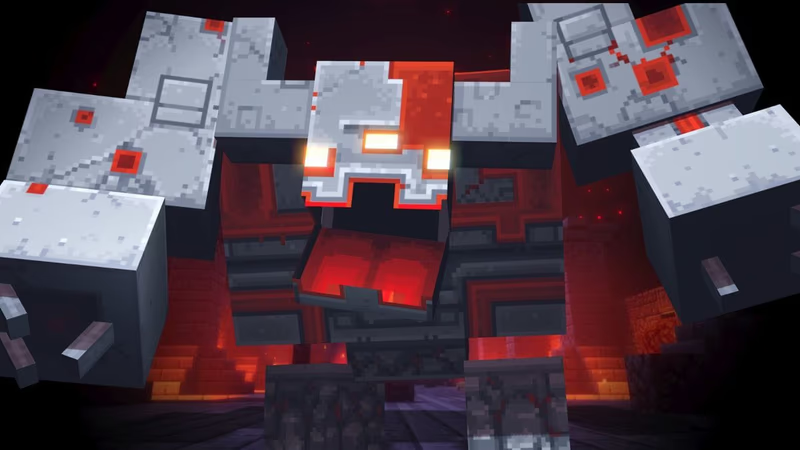
Conquer the toughest bosses in Minecraft Dungeons. Master attack patterns, exploit weak points, and equip the best builds for every major fight.