Introduction: The Darker, Grittier Side of Star Wars
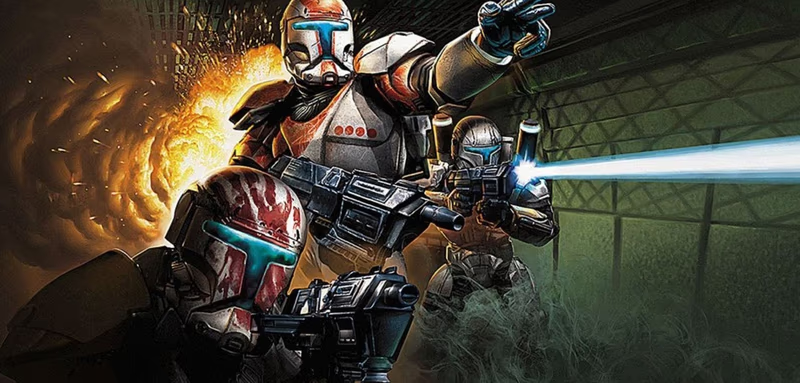
Released in 2005 during the golden era of LucasArts and right alongside the theatrical debut of Revenge of the Sith, Star Wars: Republic Commando proved that the galaxy far, far away did not need lightsabers or Jedi mysticism to deliver a masterpiece.
By stripping away the Force and shifting the perspective to the boots-on-the-ground infantry of the Grand Army of the Republic, the game introduced players to a lethal, dark, and militaristic vision of the Clone Wars.
You stepped into the armor of RC-1138 ("Boss"), the unflinching field commander of Delta Squad—an elite four-man special operations unit bred on Kamino to execute high-risk black ops behind Separatist lines.
Delta Squad: Charisma, Chemistry, and Clone Brotherhood
What transformed Republic Commando into an enduring cult classic was the distinct personality and natural chemistry of Delta Squad. Despite sharing identical genetic material, each commando brought a distinct demeanor and tactical specialty to the battlefield:
- Boss (RC-1138): The pragmatic, gravel-voiced squad leader (voiced by Temuera Morrison) who keeps the unit focused under fire.
- Scorch (RC-1262): The demolitions expert whose cynical humor and explosive enthusiasm cut through the bleakest combat drops.
- Fixer (RC-1140): The disciplined, by-the-book second-in-command and resident technical slicer.
- Sev (RC-1207): The grim, bloodthirsty sniper who turned body counts into personal competitions.
Beyond their banter, Delta Squad boasted some of the sharpest companion AI in first-person shooter history. Squadmates actively used cover, prioritized targets intelligently, and naturally fought their way through crossfire to revive you or each other without needing micromanagement.
Tactical Command and Visor HUD: Simplicity Meets Pure Immersion
LucasArts revolutionized squad mechanics by designing an intuitive, single-button contextual command system that eliminated the need for cumbersome tactical wheels:
- Contextual Squad Orders: Pointing your crosshair at highlighted environment nodes allowed you to instantly assign snipers to vantage points, order heavy anti-armor defense, trigger terminal slicing, or set up synchronized door-breach maneuvers.
- Diegetic Visor HUD: The game placed you directly behind the T-visor of Katarn-class commando armor, complete with internal tactical readouts, shield status, and squad telemetry feeds.
- The Visor Wiper: In one of the most iconic immersion details in gaming, alien viscera, droid oil, and blood splattered across your screen were physically wiped away by a laser squeegee built into the helmet.
- Bacta Revival Loop: When a commando fell, teammates could perform field revivals or send wounded soldiers to wall-mounted Bacta dispensers, keeping combat tense without forcing immediate restart screens.
Gameplay, Arsenal, and Enemies: The Modular DC-17m
Rather than forcing players to cycle through dozens of loose firearms, your loadout centered on the DC-17m Interchangeable Weapon System, a modular military rifle adaptable to any combat scenario:
- Blaster Rifle Mode: Rapid-fire suppression weapon for mid-range skirmishes.
- Sniper Rifle Attachment: High-powered energy rifle equipped with an electronic scope for precision headshots.
- Anti-Armor Attachment: High-explosive grenade launcher designed to crack through armored hulls and heavy droid plating.
This versatility was essential when facing Separatist forces that felt genuinely terrifying. B2 Super Battle Droids were towering, implacable bullet sponges that required coordinated fire to bring down, while IG-100 MagnaGuards and brutal Trandoshan mercenaries forced players to adapt rapidly between range and close-quarters melee strikes.
Campaign, Atmosphere, and the Legendary Soundtrack
The narrative spanned three distinct and atmospheric combat theaters:
- Geonosis: The chaotic frontline baptism of fire through dusty red trenches, droid foundries, and subterranean bug catacombs.
- The RAS Prosecutor: A masterclass in sci-fi survival horror where you investigate a derelict, darkened Republic assault ship taken over by scavenger boarding parties.
- Kashyyyk: Dense jungle guerrilla warfare fighting alongside enslaved Wookiee resistance fighters.
Elevating the entire experience was composer Jesse Harlin's monumental orchestral score. Driven by heavy tribal percussion and guttural, operatic chants in the fictional Mandalorian language (Mando'a)—most notably the unforgettable battle hymn "Vode An" ("Brothers All")—the music infused every shootout with an ancient, martial warrior spirit.
Pros and Cons
Pros:
- Flawless Contextual Squad Mechanics: Streamlined one-touch commands supported by exceptionally smart squadmate AI.
- Unrivaled Immersion: The diegetic helmet HUD and audio design place you directly inside the commando armor.
- Memorable Character Dynamics: Delta Squad's banter, voice acting, and distinct combat roles make them gaming icons.
- Legendary Score: Jesse Harlin's Mandalorian vocal tracks deliver one of the most unique soundtracks in Star Wars media.
Cons:
- Short Campaign: The entire story mode clocks in at roughly 6 to 8 hours.
- Spongy Heavy Enemies: High-tier enemies like B2 Super Battle Droids can exhaust massive amounts of squad ammunition.
- Unresolved Cliffhanger Ending: The emotional, sudden conclusion set up an Imperial Commando sequel that was unfortunately canceled.
Conclusion
Star Wars: Republic Commando stands as the definitive tactical shooter in the Star Wars franchise. By prioritizing squad cohesion, military realism, and unmatched presentation over generic action tropes, LucasArts delivered a tight, atmospheric masterclass in game design that remains a benchmark for companion-driven shooters.