PlayStation 5 (PS5) Hardware Analysis
The PlayStation 5 hardware architecture. We analyze Mark Cerny's custom I/O complex, the revolutionary 825GB SSD, liquid metal thermal engineering, and how Sony eradicated the traditional storage bottleneck.

Nano Banana
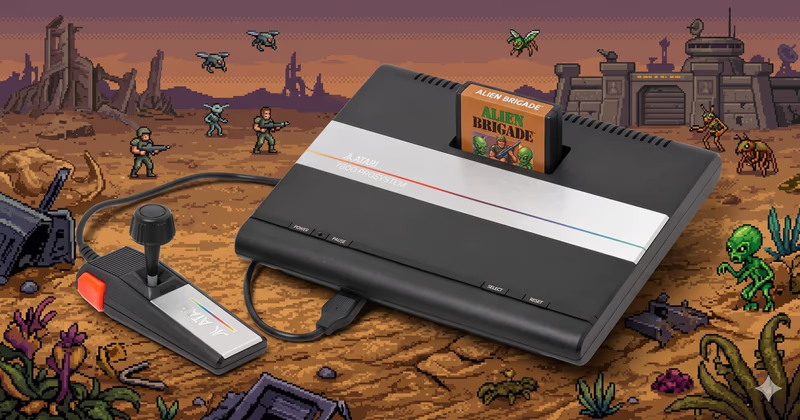
A review of the Atari 7800 ProSystem. We examine the advanced sprite-rendering capabilities of its MARIA graphics architecture, the engineering compromises of its legacy audio hardware, and the corporate restructuring that delayed its launch, ultimately repositioning a top-tier 1984 console into a budget alternative during the 8-bit war.
To analyze the Atari 7800 objectively, one must look at the specific corporate timeline of its development. Following the video game crash of 1983 and the commercial underperformance of the Atari 5200—which was heavily criticized for its lack of backward compatibility and flawed analog controllers—Atari Inc. contracted General Computer Corporation (GCC) to engineer a successor. The mandate for the 7800 was strict: deliver arcade-quality graphics and ensure native Atari 2600 compatibility.
The hardware was finalized and ready for a test market launch in the summer of 1984. However, in July of that year, Warner Communications sold the consumer division of Atari to Jack Tramiel, the former head of Commodore International. Tramiel’s immediate strategic focus was on entering the home computer market with the 16-bit Atari ST to compete with Apple and Commodore. Consequently, the console division was frozen, and the finished 7800 hardware was placed in storage. It was only when the Nintendo Entertainment System (NES) proved the console market was viable again that Atari Corporation hastily officially launched the 7800 nationwide in May 1986. By then, the hardware was already two years old.
From an engineering perspective, the 7800 is a machine of sharp contrasts, featuring a highly advanced graphics processor bottlenecked by legacy audio architecture.
Atari updated its industrial design language for the 7800, moving away from the heavy woodgrain aesthetics of the 1970s. The console featured a sleek, low-profile black plastic chassis accented by a brushed metal band and a rainbow stripe, presenting a modern, mature piece of consumer electronics.
The primary interface, however, was highly controversial. The bundled "Pro-Line" joystick was a tall, rigid stick with two fire buttons placed symmetrically on the sides of the base. Mechanically, the internal springs were exceptionally stiff, and the lateral placement of the buttons required an unnatural grip that resulted in documented hand fatigue during prolonged gameplay. Acknowledging this ergonomic flaw, Atari later released standard, NES-style flat control pads, which became the default pack-in controllers for the European market.
The most significant engineering triumph of the 7800 was its seamless backward compatibility. Unlike the 5200, which required a clunky and expensive adapter to play older games, the 7800 was designed from the silicon up to support the Atari 2600 library.
Because the motherboard already contained the legacy TIA chip and the standard 6502 architecture, the 7800 could natively boot nearly the entire library of over 400 Atari 2600 cartridges. The console featured a cartridge port engineered to accept both 7800 and 2600 PCBs without any mechanical switches. This provided the system with a massive, immediate software library on day one, serving as a major selling point for consumers upgrading from their older hardware.
The 7800's software library highlights both the strengths of the MARIA chip and the brutal realities of hardware competition in the late 1980s.
Selling approximately 3.77 million units worldwide, it secured a distant third place in the 8-bit console market, trailing behind Nintendo and Sega. However, because the R&D costs had been fully absorbed in 1984, the manufacturing costs in 1986 were exceptionally low. Atari successfully marketed the 7800 as a budget-friendly alternative—often priced under $80—aimed at older gamers who prioritized classic arcade action and backward compatibility over modern, long-form titles.
The Atari 7800 ProSystem stands as a fascinating case study in hardware engineering. It was a machine perfectly optimized for the arcade-centric market of 1984, which was strategically shelved, only to be resurrected into an industry that had fundamentally shifted its software paradigms by 1986.

Affiliate link: Support the blog via Instant Gaming at no extra cost.
Atari 7800
Others Posts
The PlayStation 5 hardware architecture. We analyze Mark Cerny's custom I/O complex, the revolutionary 825GB SSD, liquid metal thermal engineering, and how Sony eradicated the traditional storage bottleneck.
We analyze Mark Cerny's butterfly GPU architecture, the implementation of hardware-level checkerboard rendering, and the engineering tricks used to deliver a 4K experience without fragmenting the generation.

A technical breakdown of the PlayStation 3's engineering and market performance. We examine the notoriously complex Cell Broadband Engine, the split-memory bottleneck.

PlayStation 5 Pro hardware: PSSR, Advanced Ray Tracing, and the AI Revolution. We analyze Sony's PlayStation Spectral Super Resolution (PSSR), RDNA 4 Ray Tracing advancements, and the engineering behind the end of the Fidelity vs. Performance compromise.

Analysis of the PlayStation 4 and PS4 Pro hardware. We examine the shared CPU bottleneck, the mirrored butterfly GPU design, memory optimizations, and the hardware-level checkerboard rendering that enabled the 4K transition.

We explore the towering ambition, the infamously complex dual-CPU architecture, and the legendary, arcade-perfect library.


RoboCop: Rogue City: Teyon's faithful adaptation, Peter Weller's return, the sheer power of the Auto-9, and the gritty streets of Old Detroit.

Mutant Year Zero: Road to Eden: XCOM-style tactical combat, real-time stealth infiltration with Dux and Bormin, and the secrets of The Zone.
Conquer the toughest bosses in Minecraft Dungeons. Master attack patterns, exploit weak points, and equip the best builds for every major fight.

Are the Minecraft Dungeons DLCs worth buying? We break down all 6 expansions, their biomes, unique mechanics, boss fights, and rank the absolute must-haves.
games
Halo: Spartan Assault: 343 Industries' jump into the twin-stick shooter genre, the battles of Sarah Palmer, and the heavy baggage of its mobile origins.