Lost Odyssey Review: The Forgotten Masterpiece That Saved Classic JRPGs
Lost Odyssey: Hironobu Sakaguchi's Xbox 360 epic, Nobuo Uematsu's soundtrack, turn-based tactical combat, and the emotional Thousand Years of Dreams.

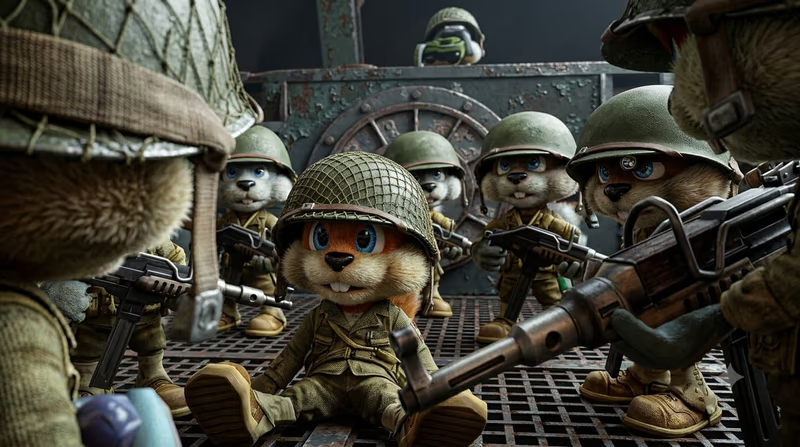
Image captured on Xbox and retouched with Nano Banana.

Rare's stunning Xbox graphics, the controversial censorship cuts, and the shift to class-based online war.
In 2005, the gaming landscape was witnessing a major shift. Microsoft had acquired Rare, and the legendary British studio needed a bold statement piece to showcase what the original Xbox hardware could do compared to its competitors.
Instead of crafting an entirely new adventure, Rare took their 2001 Nintendo 64 cult classic Conker’s Bad Fur Day, rebuilt the campaign from the ground up (Reloaded), and paired it with a massive, class-based online multiplayer mode built around Xbox Live (Live).
Visually, Live & Reloaded was an absolute marvel that easily stood as one of the most technically impressive games of the entire 128-bit generation.
The standout feature was Rare's revolutionary fur-shading technology. Conker actually looked like a soft, fluffy squirrel, complete with individual strands of fur reacting to light and movement. Combined with dynamic lighting, high-resolution textures, and vibrant color palettes, the game made contemporary titles look visually outdated.
While the frame rate would occasionally suffer minor frame drops during chaotic boss fights packed with particle effects, performance remained surprisingly stable. The reworked camera system also fixed many of the frustrating perspective issues that plagued the Nintendo 64 original.
Despite releasing on a console marketed aggressively toward older teens and adults, Live & Reloaded suffered from an incomprehensible wave of censorship.
Paradoxically, the Xbox version featured far more audio bleeps than the Nintendo 64 original. Words that passed unedited on a "family-friendly" Nintendo system were suddenly censored on Microsoft's hardware, cutting into dialogue sequences and ruining iconic comedic timing.
While the crude narrative, movie parodies (The Matrix, Alien, Saving Private Ryan), and absurd scenarios remain intact, the persistent audio bleeps undercut the sharp edge of the satire.
Instead of porting over the local couch-multiplayer minigames from the Nintendo 64 version, Rare completely replaced them with a sci-fi military third-person shooter pitting the SHC (Squirrel High Command) against the fascist Tediz.
This mode offered a full-blown 16-player online war featuring distinct character classes:
The gunplay felt arcadey yet tactical, incorporating land vehicles, aircraft, and objective-based map designs. Tight hitboxes and minimal input lag over Xbox Live made it an exceptionally forward-thinking multiplayer experience for its era, even if local party-game fans missed the original minigames.
At its core, the single-player campaign preserves the classic "Context Sensitive" mechanics. Whenever Conker encounters a specific problem, stepping onto a glowing "B" pad gives him the exact tool or ability required for the job—whether it's throwing knives, drinking beer, or firing a bazooka.
This design keeps the gameplay constantly changing, shifting from classic platforming to driving segments, rail-shooters, and boss fights.
However, some of the underlying platforming physics feel somewhat stiff by modern standards. Precision jumps can occasionally feel floaty, requiring patience during trial-and-error sequences.
Pros:
Cons:
Conker: Live & Reloaded is a stunning technical showcase that proved Rare's visual talent was second to none.
While purists may rightfully prefer the uncensored audio and local minigames of the Nintendo 64 original, this Xbox remake remains a glorious, hilarious, and visually breathtaking piece of gaming history that every retro enthusiast should experience.

Affiliate link: Support the blog via Instant Gaming at no extra cost.
Conker: Live & Reloaded
Others Posts
Lost Odyssey: Hironobu Sakaguchi's Xbox 360 epic, Nobuo Uematsu's soundtrack, turn-based tactical combat, and the emotional Thousand Years of Dreams.
SEGA and Toshihiro Nagoshi created a masterpiece of robot destruction. Here is our full retrospective on Binary Domain's lore, mechanics, and cult status.

Fishing in Shin Chan: Me and the Professor on Summer Vacation is the true economic engine of your adventure. A good fishing session is an exercise in zen and patience

In Shin Chan: Me and the Professor on Summer Vacation, catching rare bugs goes beyond the personal satisfaction of completing your encyclopedia.

Reevaluating Hideo Kojima's deeply divisive delivery simulator, a game whose themes of isolation, fractured societies, and the desperate need for connection became an eerie reality just months after its original release.

We explore the Nintendo GameCube's surprisingly muscular architecture, its quirky, toy-like design, and the brutal market realities it faced against the DVD-playing juggernauts of its era.