Introduction
Before Bethesda ever touched the license, before the Brotherhood of Steel became a household name on consoles, there was a small Interplay team led by Tim Cain building something the RPG market hadn't seen: a wasteland that didn't care whether you survived it. Fallout shipped on September 30, 1997, buried under a slate of flashier 3D titles, and quietly became the blueprint every post-apocalyptic RPG since has borrowed from. You wake up a Vault Dweller with a hundred and fifty days to find a replacement water chip before Vault 13 dies of thirst, and from that single ticking clock the game builds an entire ruined California out of raiders, mutants, and moral rot.
What made it land wasn't the premise. Dozens of games had done nuclear wastelands before. It was the insistence that every choice actually mattered, rendered through a turn-based combat system that counted every bullet and a dialogue tree that let you talk, bribe, or shoot your way past nearly anything.
Vault 13 and the Hundred-Year Clock
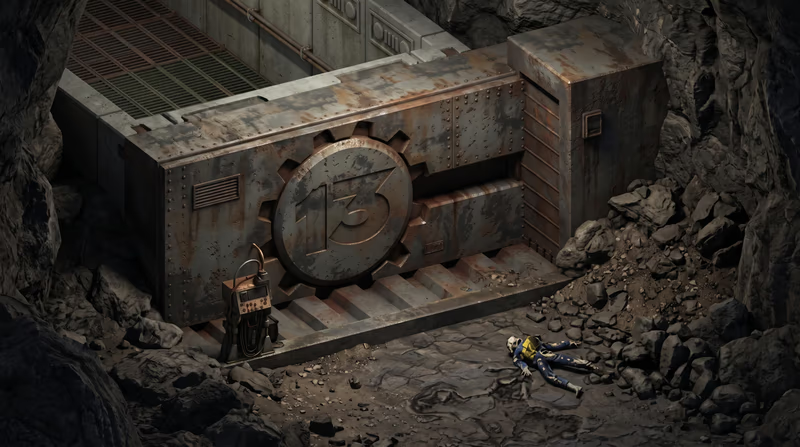
The opening hours strip away hand-holding almost entirely. Step out of Vault 13's blast door and Fallout hands you a ruined map of Southern California with no quest marker, no waypoint, nothing but a Pip-Boy and a deadline. The Hub, Junktown, and the Boneyard aren't theme-park zones built around a critical path. They're settlements that existed before you arrived and will keep running their own rackets whether you help or ignore them entirely.
That time pressure is a bluff in the most interesting way: the game nudges you toward urgency, then rewards players who go explore anyway. Finding the Glow or recruiting Ian without ever touching the main quest line feels less like sequence-breaking and more like the game trusting you to make your own priorities.
- Water Chip Deadline: A soft 150-day (later extended to 500) countdown that pressures the player without hard-blocking exploration.
- The Hub: A sprawling trade city built from competing caravan companies, each with its own quests and betrayals.
- The Glow: An optional pre-war research facility packed with lore and some of the game's toughest radiation hazards.
The SPECIAL System and Turn-Based Combat
Tim Cain and Christopher Taylor started Fallout as a GURPS adaptation before Steve Jackson Games balked at the violence, and what emerged from that fallout (the pun is unavoidable) was SPECIAL: Strength, Perception, Endurance, Charisma, Intelligence, Agility, Luck. Seven stats that don't just gate dialogue options, they rewrite entire playthroughs. A high-Intelligence build talks its way through confrontations a brute-force Strength build would have to shoot through, and a low-Intelligence character gets an entirely different, deliberately broken dialogue tree as a reward for committing to the bit.
Combat runs on action points spent per turn, with aimed shots at the eyes, groin, or limbs carrying real tactical weight instead of being a cosmetic flourish. Critical failures can jam a weapon or blow off your own character's arm. It's slower and more punishing than real-time alternatives, but every exchange of gunfire reads like a puzzle you solved or botched, not a reflex test.
- Action Point Economy: Every move, reload, and shot costs AP, forcing real tactical trade-offs each turn.
- Targeted Attacks: Called shots to specific body parts trade accuracy for devastating, often crippling effects.
- Skill Checks Everywhere: Lockpick, Science, and Speech skills open entire alternate paths through quests that never require firing a shot.
A Wasteland Full of Consequence
Fallout's reputation as a design touchstone comes down to one thing: it rarely punishes you for a choice by simply ending the game. Side with the Khans, sell out Junktown's sheriff, or nuke Megaton's predecessor town, the Hub, with the wrong caravan deal, and the world reshapes around the fallout instead of handing you a game-over screen. The ending sequence famously tallies every settlement you touched and narrates its fate based on exactly what you did there, good, bad, or indifferent.
Companions reinforce the same philosophy. Ian, Tycho, and Dogmeat aren't scripted cutscene characters, they're AI-controlled squadmates who can die permanently in a firefight you mismanaged, and the game doesn't resurrect them for the sake of a story beat.
Black Humor in a Dead World
Where other post-nuclear fiction plays it grim and straight, Fallout leans into absurdist 1950s Americana curdled by radiation. Talking deathclaws in a later DLC, a cult literally worshipping an unexploded nuclear bomb, a Boneyard gang called the Blades running on pure street-punk bravado. The writing treats the apocalypse as dark comedy as often as tragedy, and that tonal whiplash became the series' signature long before Bethesda picked up the license.
The Vault-Tec propaganda posters, the Pip-Boy's cheerful retro-futurist UI, the radio jingles playing over scenes of raider camps, all of it sells a world that's horrifying precisely because it's still smiling.
Pros and Cons
Pros:
- Meaningful Choice Architecture: Nearly every quest has multiple solutions that genuinely alter the ending slideshow.
- SPECIAL Character Building: Stat and skill investment changes entire playthroughs rather than just combat numbers.
- Tactical Turn-Based Combat: Action points and called shots make every encounter a real decision tree.
- Tone and Writing: Black comedy and 1950s retro-futurism give the wasteland a voice no competitor matched at the time.
Cons:
- Steep Interface Learning Curve: Inventory management and skill checks are opaque by modern standards, with little in-game guidance.
- Permadeath Companions: Losing Ian or Tycho to a bad firefight with no warning can feel more frustrating than fair.
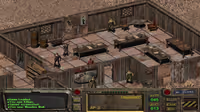
- Dated Presentation: Isometric sprites and MIDI-era audio require patience from players used to modern production values.
Conclusion
Fallout isn't preserved as a museum piece, it's still a functional, demanding CRPG that treats its player like an adult capable of living with bad decisions. Nearly thirty years on, the SPECIAL system and the Hub's web of competing factions remain the standard every wasteland RPG since has been measured against, Bethesda's own sequels included.