Introduction
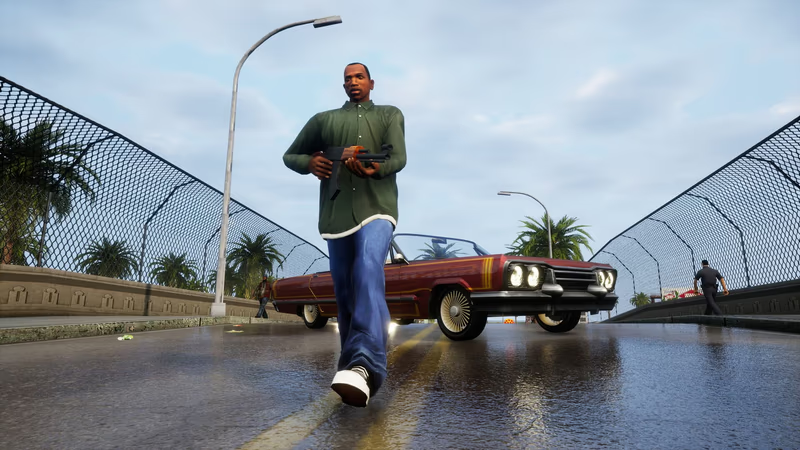
By 2004, Rockstar had already proven it could build a convincing city with Vice City. San Andreas asked a bigger question: what happens if you build an entire state. The answer was Los Santos, San Fierro, and Las Venturas stitched together by open desert, forest, and mountain, a map roughly five times the size of its predecessor and dense enough that you could lose an afternoon just driving the back roads. Carl "CJ" Johnson comes home to Los Santos for his mother's funeral and finds the Grove Street Families scattered, corrupt cops circling, and his own brother pointing fingers. What starts as a story about one family's collapse spreads into a five-year chronicle of gang war, heists, and a kid from the projects clawing his way into rooms he was never supposed to enter.
Los Santos, San Fierro, and Las Venturas: A State to Call Your Own
Rockstar didn't just scale up Vice City's footprint, it built three distinct cities with their own identities and dropped a working rural interior between them. Los Santos apes early-90s South Central Los Angeles down to the gang graffiti and lowrider culture. San Fierro borrows San Francisco's hills and cable-car energy. Las Venturas recreates the Vegas strip, complete with a casino economy you can actually gamble against. Connecting them is Red County, Flint County, Whetstone, and Tierra Robada, a landmass of farmland, wilderness, and a small military base that rewards exploration rather than punishing it with loading screens.
- Three-city structure: each city unlocks in sequence as the story progresses, so the map never feels like an empty sandbox dumped on you at hour one.
- San Andreas countryside: forests, deserts, and a dedicated mountain (Mount Chiliad) give the game a sense of geography that Vice City's single island never attempted.
- Area 69: a restricted military zone tucked into the desert, a direct nod to Area 51 that rewards players who go looking for trouble.
The jump in scale alone would have been a headline feature. Rockstar backed it with density, every district has its own radio chatter reference, its own gang color, its own texture.
Carl Johnson: A Protagonist Rockstar Could Finally Write
Claude from GTA III barely spoke. Tommy Vercetti snarled one-liners. CJ is the first Rockstar protagonist with a real arc, a man returning to a neighborhood that no longer trusts him, trying to rebuild Grove Street while his own crew doubts his loyalty. Voice actor Young Maylay carries scenes that swing between grief, fury, and dry humor without the tonal whiplash feeling forced. The writing leans hard into early-90s West Coast hip-hop and gang culture references, and while the satire can be blunt, it's never lazy, Rockstar clearly did the research on the period it's lampooning.
The corrupt C.R.A.S.H. officer Frank Tenpenny, voiced by Samuel L. Jackson, does more to drive the plot than almost any other character in the series up to that point. He blackmails CJ into running jobs across the entire state, which doubles as Rockstar's narrative justification for why a street-level gangster ends up flying jets and infiltrating a casino. It's a clever structural trick, every ridiculous mission has a story reason to exist.
RPG Mechanics and Customization
San Andreas bolted genuine RPG systems onto the GTA formula for the first time, and the experiment mostly pays off. CJ has a Fat stat and a Muscle stat that respond to what he eats and how often he hits the gym, a Stamina bar that extends with running and swimming, and individual skill ratings for every weapon class that improve through use. Eat too much junk food and CJ visibly gets heavier, which tanks his Sex Appeal stat and his stamina, letting the player's habits leave a physical mark on the character.
- Customization at Binco and Pro-Laps: clothing, haircuts, and tattoos change how NPCs react to CJ, including a Respect stat that gates story missions.
- Gyms across the map: training builds Muscle and unlocks new wrestling-style melee moves, tying fitness directly to combat effectiveness.
- Weapon skill progression: firing a pistol or shotgun enough times unlocks faster reloads, dual-wielding, and tighter accuracy, rewarding players who stick with a loadout.
- Property ownership: CJ can buy safehouses across all three cities, giving players actual reasons to care about territory beyond mission waypoints.
None of this depth existed in Vice City. It turns San Andreas into something closer to an action RPG wearing a crime drama's clothes.
Gang Warfare and Territory Control
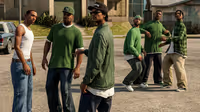
Once the main story opens up Los Santos' gang war arc, San Andreas introduces territory control, a system where CJ can walk his crew into rival Ballas turf, trigger a shootout, and flip the block green on the map. Hold enough territory and Grove Street members start spawning to back CJ up on the street, turning random encounters into actual firefights with allies instead of a lone gunman against the world. It's a simple loop, start a fight, win it, watch the turf change color, but it gives the mid-game a sense of forward momentum that the main missions alone don't always provide.
- Territory capture: controlling a district reduces the chance of rival gang ambushes nearby and increases the strength of CJ's backup.
- Grove Street allies: recruitable gang members follow CJ into fights, a precursor to the companion systems later Rockstar games would expand on.
- Risk of losing ground: rival gangs can retake territory if CJ neglects it, so the system punishes players who ignore it for too long.
Pros and Cons
Pros:
- Unmatched scale for its generation: three cities and a full countryside gave players more to explore than any open-world game on PlayStation 2.
- CJ as a real character: a protagonist with family stakes, genuine growth, and a cast of well-acted supporting characters around him.
- RPG systems that matter: stats, customization, and weapon skill progression give long-term reasons to keep playing beyond the story missions.
- A legendary soundtrack: eleven radio stations spanning G-funk, funk, classic rock, and talk radio that still hold up as period pieces.
- Territory warfare: a genuinely satisfying mid-game loop that rewards players for engaging with the map beyond the main story path.
Cons:
- RenderWare's technical ceiling: pop-in, muddy textures, and frame-rate dips show up constantly once the draw distance stretches across the open countryside.
- Mission design inconsistency: a handful of missions (the jetpack-flying "Supply Lines" chief among them) lean on frustrating difficulty spikes rather than clever design.
- Flight school and driving tests: some skill-gated missions feel like padding rather than meaningful content, and they block story progress if failed repeatedly.
- Dated satire in places: some of the period-specific humor hasn't aged gracefully, even if the research behind it was clearly thorough.
Conclusion
San Andreas is the moment Rockstar stopped making bigger Vice Cities and started making something closer to a living simulation of a state. The RenderWare engine groans under the weight of its own ambition more than once, but the sheer density of CJ's journey, from a torn-apart Grove Street to the top of the Las Venturas casino food chain, still outpaces most open-world games released a decade later. It's the series' most personal story wrapped around its most audacious map, and two decades on it remains the high-water mark for what the PS2 generation could pull off.