The Witcher Review: CD Projekt's Dark Fantasy Debut
CD Projekt RED's 2007 debut adapted Andrzej Sapkowski's novels into a gritty, choice-driven RPG that put the fledgling studio on the map.
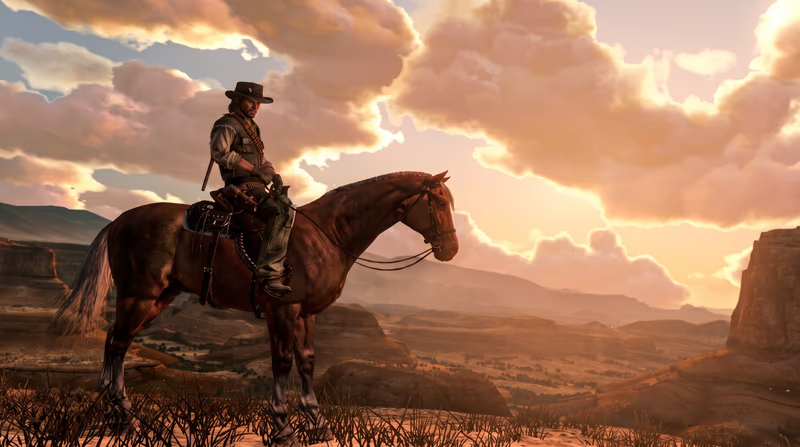
John Marston rides into New Austin in Rockstar's 2010 western epic.

By 2010, Rockstar North had already proven it could build a city that felt alive with Grand Theft Auto IV. Rockstar San Diego took that same ambition and pointed it somewhere far less crowded: the dying frontier of 1911, where the automobile is just starting to choke out the horse and the last outlaws are running out of places to hide. Red Dead Redemption isn't a remake of the studio's 2004 cult western Red Dead Revolver, it's a near-total reinvention, built on the RAGE engine and soaked in the mournful tone of films like The Wild Bunch and Unforgiven. New Austin, West Elizabeth, and Mexico don't just look the part, they feel emptied out, sun-bleached, and running on borrowed time.
The map is the first thing that announces what kind of game this is. New Austin's scrub deserts give way to West Elizabeth's pine forests and finally to Mexico's dusty border towns, each region shifting in color palette, accent, and architecture as you cross it on horseback. Rockstar didn't scatter busywork icons across this terrain, it built stagecoach ambushes, bounty hunts, and random encounters that only trigger if you're paying attention to the road in front of you.
John Marston isn't a blank-slate protagonist. He's a reformed gunslinger, blackmailed by federal agents into hunting down his old gang, and every line Rob Wiethoff delivers carries the weight of a man who knows exactly what he used to be. The writing never lets him off easy, his new life as a rancher with a wife and son is constantly undercut by the violence the plot forces him back into.
Combat leans on cover-based third-person shooting, the same DNA as GTA IV, but Dead Eye targeting is what separates this from any contemporary shooter. Time slows, you tag weak points with the right stick, and Marston unloads a chain of shots the instant you let go. It's cinematic without being a cheat code, since ammo and Dead Eye meter both run out fast if you lean on it.
Rockstar leaned hard on the Euphoria physics engine to make every death and collision look uniquely awkward and real, horses stumble on uneven terrain, NPCs ragdoll believably off rooftops, and gunfights rarely play out the same way twice. Random events, a wagon under attack, a man trapped under his own horse, a bounty fleeing on foot, fire constantly and without a map marker, rewarding players who actually watch the horizon instead of chasing icons.
Pros:
Cons:
Red Dead Redemption earns its reputation not through spectacle but through restraint, Rockstar San Diego built a frontier that mourns its own disappearance and handed players a protagonist who can't outrun his past no matter how far west he rides. The Mexico chapter sags and the shooting AI hasn't aged gracefully, but neither dents a game that turned a dying genre into one of the defining open-world experiences of its generation.
Affiliate link: Support the blog via Instant Gaming at no extra cost.
Red Dead Redemption
Others Posts
CD Projekt RED's 2007 debut adapted Andrzej Sapkowski's novels into a gritty, choice-driven RPG that put the fledgling studio on the map.
Warhorse Studios' 2018 debut swapped fantasy tropes for obsessively researched medieval Bohemia, building one of the most punishing and rewarding RPGs of its generation.
Jason Brody's descent into hell, Vaas Montenegro's overwhelming charisma, and the formula that redefined Ubisoft forever.
Reevaluating Hideo Kojima's deeply divisive delivery simulator, a game whose themes of isolation, fractured societies, and the desperate need for connection became an eerie reality just months after its original release.

Shadow of the Colossus: Fumito Ueda's timeless journey, its lonely world, Wander's tragic quest, and the majesty of the 16 colossi.
Grand Theft Auto: San Andreas sent CJ across three fictional cities and an entire state, building the biggest, most ambitious open world of the PS2 era.
A newcomer's guide to Portal 2's controls, gel and funnel mechanics, and co-op basics - everything you need before Aperture Science starts testing you for real.
A practical, course-by-course guide to Super Mario 64 - how to navigate Peach's Castle, which Stars to chase first, and how to actually get all 120 without wasting hours on the ones that trip everyone up.

An engineering retrospective on the Nintendo Game Boy Color. We explore how a double-speed Sharp SM83 core, a backward-compatible palette-mapped color LCD, and translucent 'Atomic Purple' shells turned a stopgap handheld into the system that carried Pokémon's second generation.

Analysis of the PlayStation 4 and PS4 Pro hardware. We examine the shared CPU bottleneck, the mirrored butterfly GPU design, memory optimizations, and the hardware-level checkerboard rendering that enabled the 4K transition.
guides
Ten essential tips for starting Yakuza 0: managing early yen before Real Estate Royale and Cabaret Club Czar open up, navigating Kamurocho and Sotenbori without getting lost, and understanding the save system so you never lose progress.