Introduction: The True "Final Fantasy" of the Xbox 360 Era
During the late 2000s, Microsoft embarked on an ambitious mission to win over the Japanese gaming market. To achieve this, they backed Mistwalker—the studio founded by Final Fantasy creator Hironobu Sakaguchi—to build the ultimate next-generation JRPG for the Xbox 360.
The result was Lost Odyssey, a sprawling four-disc epic that assembled a legendary JRPG dream team:
- Hironobu Sakaguchi: Story and game design.
- Nobuo Uematsu: Full orchestral score.
- Takehiko Inoue: Character design (acclaimed manga artist behind Slam Dunk and Vagabond).
While mainstream franchises were shifting toward real-time action, Lost Odyssey doubled down on traditional turn-based roots, delivering what many fans consider the true spiritual successor to Golden Age Final Fantasy.
Narrative and the Burden of Immortality: The Story of Kaim Argonar
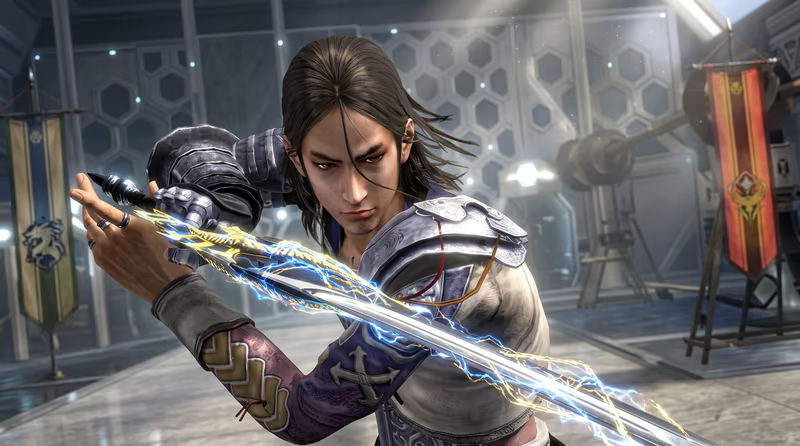
The story centers on Kaim Argonar, a stoic warrior cursed to live for 1,000 years who has lost his memories. Set against the backdrop of a Magical Industrial Revolution powered by Grand Staff engine technology, Kaim is drawn into a global geopolitical conflict.
Unlike typical JRPG power fantasies, Lost Odyssey treats immortality as a devastating tragedy.
Kaim is not a chosen savior celebrating eternal youth; he is a broken soul who has watched wives, children, friends, and entire empires crumble into dust for a millennium while remaining completely unchanged.
"A Thousand Years of Dreams": Literature Within a Video Game
The narrative masterpiece within Lost Odyssey comes in the form of short stories titled "A Thousand Years of Dreams," written by award-winning Japanese author Kiyoshi Shigematsu.
As Kaim encounters specific triggers throughout the world, suppressed memories resurface as interactive prose vignettes. Accompanied by minimal background art, subtle particle effects, and melancholy Uematsu piano compositions, these stories explore themes of grief, human warmth, war, and mortality.
These text-based sequences deliver more raw emotional weight than almost any multi-million-dollar CGI cutscene in the history of the genre.
Combat System: Traditional Turn-Based Mechanics with Tactical Twists
Combat honors classic turn-based structures while introducing clever tactical refinements:
- Aim Ring System: When executing physical attacks, a ring shrinks over a target. Timing your button release perfectly yields "Good" or "Perfect" ratings, adding elemental damage or status effects.
- Guard Condition (GC): Frontline party members generate a protective defense barrier for fragile backline spellcasters. To deal substantial damage to enemy mages, you must first break down the enemy's frontline GC.
- Skill Link Progression: Immortal party members cannot learn skills from leveling up. Instead, they acquire abilities by equipping accessories or bonding (Skill Link) with mortal party members over time, offering endless party customization.
Nobuo Uematsu delivered one of the finest soundtracks of his storied career. From heart-pounding boss themes driven by heavy brass to quiet, tragic melodies during memory sequences, the music elevates every single moment.
Visually, the game utilized Unreal Engine 3 to create vast, detailed environments and cinematic spell animations.
While the original Xbox 360 release suffered from frequent disc-swapping and lengthy load times entering battles, modern backwards compatibility on Xbox Series X/S completely eliminates performance hitches, running the game at rock-solid frame rates with near-instant loading.
Pros and Cons
Pros:
- Deep, Emotional Storytelling: The "Thousand Years of Dreams" vignettes are a high-water mark for video game writing.
- Masterpiece Soundtrack: Nobuo Uematsu at the absolute top of his creative game.
- Refined Combat System: Excellent synergy between the Aim Ring mechanics, Guard Condition positioning, and Skill Link customization.
Cons:
- Steep Initial Difficulty Spikes: The first two boss fights feature severe difficulty jumps that can punish unprepared players.
- Uneven Secondary Cast: While immortals like Kaim and Seth are phenomenal, a few mortal party members feel cliché.
- Original Hardware Slowdowns: The original 2007 Xbox 360 release had slow battle transitions (though fully fixed on modern hardware).
Conclusion
Lost Odyssey stands as a monumental triumph for classical role-playing games. By pairing mature themes of immortality and grief with a brilliant turn-based combat system, Mistwalker crafted an unforgettable masterpiece that has aged like fine wine.
If you have any passion for traditional JRPGs, this timeless gem remains an essential adventure that deserves a spot in every gamer's library.