Introduction
Sequels to beloved short games usually fail in one of two predictable ways: they pad the original idea past its breaking point, or they chase scale and lose the thing that made the first game sharp. Portal 2, released April 2011, did neither. Valve took a three-to-five-hour cult hit built on a single mechanic and expanded it into an eight-to-ten-hour campaign with a dedicated co-op mode, new physics toys, and a supporting cast that outgrew the original's one-woman show. By any reasonable law of sequel physics, this should not have worked as well as it did.
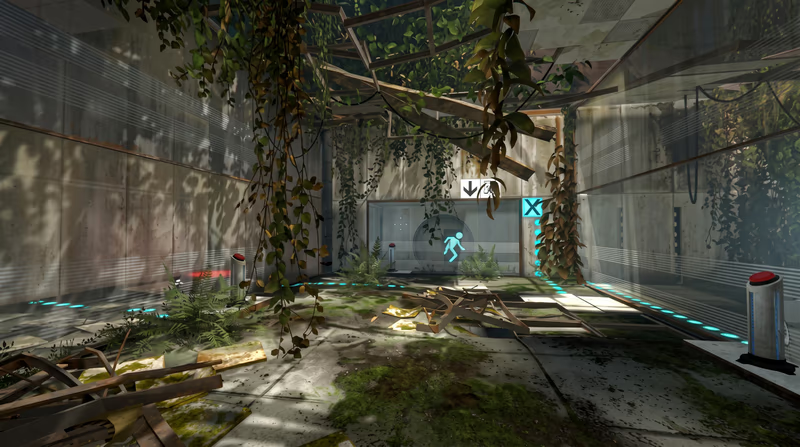
It opens on a joke almost cruel in its patience: Chell wakes from stasis decades after the first game's events, Aperture Science has rotted into an overgrown ruin, and the first voice she hears belongs not to GLaDOS but to a nervous, well-meaning personality core named Wheatley. The pacing of that opening hour, rebuilding trust in a broken facility before the plot even restarts the testing track, tells you immediately this isn't a retread.
New Tools: Gels, Funnels, and Light Bridges
The original portal gun returns unchanged, which is exactly right, but Portal 2 refuses to let the sequel coast on the same forty puzzles with a new coat of paint. Three new systems arrive mid-campaign, each one forcing a full re-evaluation of how chambers get solved.
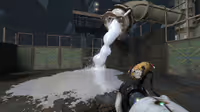
- Propulsion and Repulsion Gel: orange gel launches anything it touches at speed, blue gel turns any surface into a trampoline, and combining both across a portaled chamber turns puzzle-solving into something closer to pinball engineering.
- Excursion Funnels: tractor-beam corridors that carry objects, and Chell, along fixed paths, including through portals, which Valve uses to build some of the campaign's most visually inventive set pieces.
- Hard Light Bridges: solid, walkable beams of light that block turret fire and redirect momentum, giving chambers a third axis of problem-solving beyond pure portal geometry.
None of these feel bolted on. Each mechanic gets its own multi-chamber arc, introduced in isolation and then recombined with the others and the original gun, which is the same disciplined curriculum structure that made the first game's test track work, just with triple the vocabulary.
Wheatley and GLaDOS: A Double Act
Stephen Merchant's Wheatley is the game's masterstroke. He's chatty, anxious, and constantly undercutting his own authority, the exact inverse of GLaDOS's clipped menace, and pairing the two of them for the back half of the campaign produces some of the funniest writing in any Valve game. When Wheatley eventually seizes control of the facility, his descent into GLaDOS-style megalomania is played for both comedy and genuine unease, a character arc that earns its twist instead of just delivering one.
J.K. Simmons joins as Cave Johnson, Aperture's long-dead founder, heard only through pre-recorded announcements scattered across the facility's abandoned 1950s-era labs. Johnson's recordings do more worldbuilding in a handful of lines than most games manage with an entire codex, sketching a company that was reckless, delusional, and doomed decades before Chell ever set foot inside it. GLaDOS herself gets a redemption arc that could have felt cheap and instead lands because the writers never soften her cruelty, they just give her a reason to point it somewhere else.
The Old Aperture Science Ruins
The mid-game detour through Aperture's original 1950s facility is the strongest environmental storytelling Valve has produced. Rusted machinery, hand-painted signage, and the crumbling bones of test chambers built decades before GLaDOS existed turn the campaign's midsection into an archaeology dig disguised as a puzzle gauntlet. The shift from the clean, modern test chambers of the opening act to this collapsed substructure resets the game's visual language entirely, and the puzzles adapt with it, improvised out of broken infrastructure rather than purpose-built chambers.
It's also where the gel mechanics get their best showcase, since the ruined sections give Valve license to build chaotic, half-destroyed spaces that a sterile modern test chamber never could. Climbing out of that ruin and back into Aperture's rebuilt present-day facility hits harder because of how long the game let you sit in the wreckage first.
Co-op: Atlas, P-Body, and a Second Campaign
Portal 2's co-op campaign isn't a tacked-on multiplayer mode, it's a separate story with its own chambers, built from the ground up around two robots, Atlas and P-Body, who can each place their own pair of portals. That doubles the puzzle space instantly: four portals active simultaneously means solutions built around passing objects, and each other, through combinations no single-player chamber could support.
- Four-portal puzzles: chambers require constant coordination between both players' portal pairs, turning communication into as much of a skill as spatial reasoning.
- Wordless physical comedy: Atlas and P-Body can't speak, so the co-op campaign leans on slapstick animations and emote gestures, and it works better than dialogue would have.
Running the co-op campaign solo by swapping between both bots is possible but misses the point entirely. This mode wants a second player in the room, or at least on a call, and rewards that cooperation with some of the cleverest four-portal puzzles Valve has ever shipped.
Pros and Cons
Pros:
- Doubled toolset, zero bloat: gel, funnels, and light bridges each earn a full arc of dedicated puzzles instead of feeling like filler additions.
- Wheatley: a comic antagonist whose turn toward menace is genuinely unsettling rather than a cheap swerve.
- The Aperture ruins: the strongest environmental storytelling stretch in any Valve game.
- A real co-op campaign: built on its own puzzle logic, not a single-player mode retrofitted for two.
- Writing density: Cave Johnson's recordings alone contain more characterization than most games' entire scripts.
Cons:
- A slower start: the facility-reboot opening, while purposeful, delays the portal gun's return longer than some players will have patience for.
- Co-op demands a partner: the mode's best puzzles require genuine two-person coordination, which thins the experience considerably when played alone against the AI-controlled swap.
- Less mechanical surprise than the original: Portal's single, novel mechanic hit harder as a first discovery than Portal 2's incremental additions ever can.
Conclusion
Portal 2 had no business being this good. A short, singular cult classic built around one idea somehow became a longer, funnier, more mechanically generous game without diluting anything that made the original special. Wheatley and Cave Johnson prove Valve's writing bench runs deeper than one sardonic AI, the gel and funnel mechanics justify the sequel's existence on pure design terms alone, and the co-op campaign stands as one of the smartest two-player puzzle modes ever shipped. Few sequels improve on a perfect original. This one does.