Star Wars: Republic Commando Review: The Tactical Masterpiece of Delta Squad
A retrospective on Star Wars: Republic Commando: LucasArts' gritty military shooter, the brotherhood of Delta Squad, the iconic visor HUD, and the power of "Vode An."

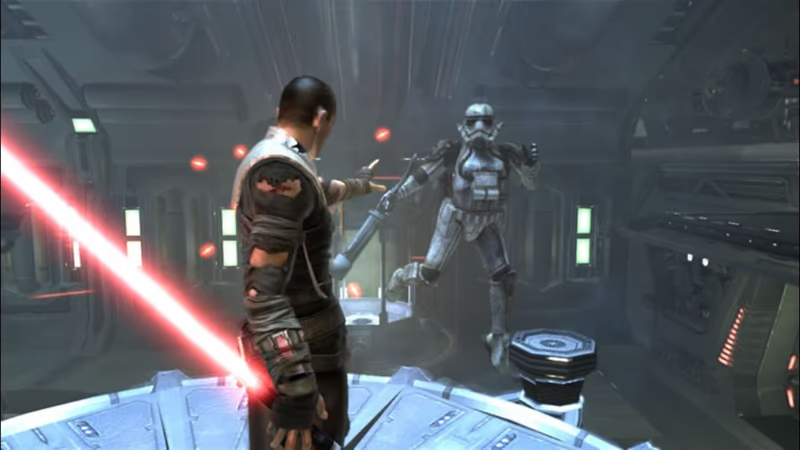
Starkiller bends a Star Destroyer out of orbit in one of The Force Unleashed's signature Force Pull set-pieces.

For thirty years the gap between Episode III and Episode IV sat empty, a blank stretch of galactic history covered only by Expanded Universe novels. LucasArts filled it with a lie Darth Vader needed to keep: a secret apprentice, raised from childhood in the ruins of a crashed Jedi cruiser on Kashyyyk, trained in private to hunt down the remnants of the Jedi Order. His name is Galen Marek, and the game calls him Starkiller. Released September 16, 2008 across PlayStation 3, Xbox 360, PC, and a mechanically distinct Wii/PS2/PSP build, The Force Unleashed arrived positioned as a tentpole, not a tie-in. George Lucas himself reportedly treated its story outline as canon enough to shape later Expanded Universe material, and the marketing leaned hard into one pitch: this is what it looks like when the dark side actually works the way the movies always promised.
The plot opens cold, dropping players into the body of Jedi Master Kento Marek's murder at Vader's hands on Kashyyyk, then jumps a decade forward to the apprentice that killing produced. Starkiller spends the first act hunting surviving Jedi across Raxus Prime's junk-moon wastelands and the Wookiee homeworld itself, each target a named survivor of Order 66 rather than a generic saber-wielding mook. The hook sharpens once Vader's actual agenda surfaces: he's rebuilding the instrument of his own betrayal, grooming an apprentice strong enough to one day help him kill Emperor Palpatine. Sam Witwer's voice work carries Starkiller through a believable arc from unquestioning killer to someone who starts asking who benefits from his loyalty, and Vader himself (voiced by Matt Sloan, performance-captured against Witwer) comes across colder and more calculating than almost any other game depiction of the character before or since. The back half, built around a Rebel cell forming under Starkiller's protection, runs out of the same narrative momentum, but the opening three or four hours justify the canon-adjacent hype entirely on their own.
What actually sold the fantasy wasn't the story, it was the engine underneath it. LucasArts built the HD consoles' version on their in-house Ronin Engine, stacking Havok physics against two licensed systems: NaturalMotion's Euphoria for procedural ragdoll animation, and Pixelux's Digital Molecular Matter for destructible environments. Stormtroopers don't play a single death animation when you Force Push them off a platform, they flail and grab at ledges and ragdoll into crates with momentum that reacts to exactly how hard you threw them. DMM lets you Force Pull a chunk of wall off its hinges and swing it through a squad like a wrecking ball, the geometry fracturing differently depending on the angle of impact. It's the rare licensed-engine showcase that actually changes how a level plays rather than just how it looks, and a full decade before Jedi: Fallen Order revisited lightsaber combat, this was the first time a Star Wars game let you treat the environment itself as a weapon.
Combat splits cleanly between melee combos and Force powers, and leans hard on the latter. Starkiller's lightsaber work is serviceable but unremarkable, a handful of combo strings that rarely demand real precision. The powers are where the design team's energy clearly went: Force Push staggers groups, Force Grip lifts single enemies for aerial throws or point-blank lightning blasts, and Force Repulse clears a room in a shockwave that sends troopers cartwheeling into walls. Mastering the combo system means chaining these together rather than mashing the saber button, grabbing a trooper mid-push, holding him airborne, then detonating him into his own squad. The Sith Lords, Shadow Guards, and Jedi Masters who serve as actual boss fights force you to use every tool at once, since they shrug off straightforward saber pressure and punish players who never learned the Force kit beyond Push.
This is also where the game's ambition runs into its ceiling. Levels are rigidly linear corridors dressed up as open battlefields, funneling players through scripted set-pieces rather than letting the sandbox-feeling physics breathe across an actual sandbox. The Kashyyyk and Felucca stages hold up as genuine highlights, stacking destructible cover and vertical combat against the Wookiee jungle canopy, but the TIE Fighter construction facility and later Death Star-adjacent stretches drag through repetitive wave-based combat that the story doesn't earn. Boss encounters fare better: the duel against Jedi Master Rahm Kota recontextualizes everything you've learned about enemy AI, since Kota reads and counters Force powers the way a trained Jedi should, and the climactic confrontation on the second Death Star against the Emperor himself closes the game on genuinely tense, high-stakes choreography rather than a simple damage-sponge gauntlet.
Pros:
Cons:
The Force Unleashed never fully closes the gap between what its physics engine promises and what its level design actually delivers, but Starkiller's story and the sheer novelty of watching the dark side bend a Star Destroyer out of the sky make it worth the ride anyway. It's a flawed, ambitious swing that still landed hard enough to reshape how the galaxy between the trilogies gets told.

Affiliate link: Support the blog via Instant Gaming at no extra cost.
Star Wars: The Force Unleashed
Others Posts
A retrospective on Star Wars: Republic Commando: LucasArts' gritty military shooter, the brotherhood of Delta Squad, the iconic visor HUD, and the power of "Vode An."
In an era where third-person shooters were defined by chest-high walls, muddy color palettes, and slow, methodical pacing, PlatinumGames decided to strap rocket boosters to the genre's knees. Directed by the legendary Shinji Mikami

Is Crysis just a hardware-melting benchmark or a genuine FPS masterpiece? We analyze CryEngine 2, Nanosuit mechanics, destructible physics, and the controversial Ceph shift.

How Epic Games took a blockbuster action shooter and transformed it into a devastating, character-driven war epic that redefined the Xbox 360 era.

Shadow of the Colossus: Fumito Ueda's timeless journey, its lonely world, Wander's tragic quest, and the majesty of the 16 colossi.
A newcomer's guide to Portal 2's controls, gel and funnel mechanics, and co-op basics - everything you need before Aperture Science starts testing you for real.

A practical, course-by-course guide to Super Mario 64 - how to navigate Peach's Castle, which Stars to chase first, and how to actually get all 120 without wasting hours on the ones that trip everyone up.

An engineering retrospective on the Nintendo Game Boy Color. We explore how a double-speed Sharp SM83 core, a backward-compatible palette-mapped color LCD, and translucent 'Atomic Purple' shells turned a stopgap handheld into the system that carried Pokémon's second generation.

Analysis of the PlayStation 4 and PS4 Pro hardware. We examine the shared CPU bottleneck, the mirrored butterfly GPU design, memory optimizations, and the hardware-level checkerboard rendering that enabled the 4K transition.
guides
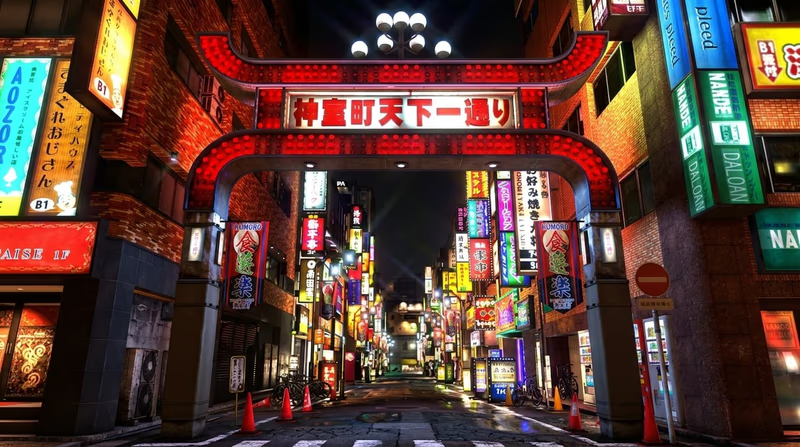
Ten essential tips for starting Yakuza 0: managing early yen before Real Estate Royale and Cabaret Club Czar open up, navigating Kamurocho and Sotenbori without getting lost, and understanding the save system so you never lose progress.