The Legend That Paralyzed the Industry
Back in late 2007, Crytek dropped a bomb on the PC gaming community. Coming off the success of Far Cry, the studio unleashed CryEngine 2 alongside a new sci-fi shooter: Crysis.
It was not just a game; it was a technological monster that melted high-end graphics cards for nearly a decade, spawning the ultimate industry meme: "Can it run Crysis?"
Yet behind the staggering visual benchmark sat a brilliant open-ended tactical shooter that rewarded player creativity just as much as raw hardware specs.
The Nanosuit: The Real Engine of Gameplay
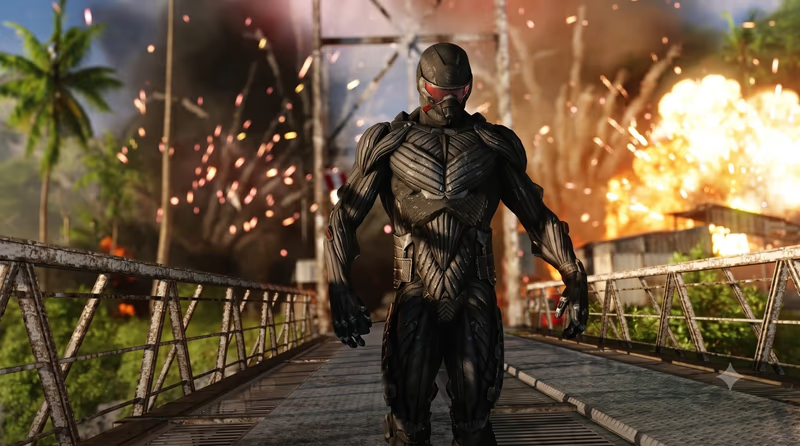
While the graphics grabbed headlines, the High-Tech Nanosuit was the true soul of the gameplay loop. The suit granted four distinct, instant-toggle abilities:
- Maximum Armor: Absorbs incoming damage at the cost of suit energy.
- Maximum Strength: Lets you jump onto rooftops, punch through walls, or throw enemy soldiers into their comrades.
- Maximum Speed: Enables rapid sprints to flank enemy positions or escape sticky situations.
- Cloak: Renders you nearly invisible for stealth infiltrations and silent takedowns.
Complementing this was the real-time weapon customization system. Without pausing the action or wading through menus, you could attach silencers, laser sights, tactical scopes, or grenade launchers on the fly, completely transforming your gunplay strategy mid-firefight.
Lingshan Island: Tactical Freedom and Destructible Physics
The first half of Crysis takes place across the lush, open jungle of Lingshan Island. Crytek handed players an objective and complete freedom regarding how to accomplish it.
You could hijack a patrol boat, sneak through dense foliage using Cloak, or drive a military jeep through the front gate with Maximum Armor engaged.
The physics engine was mind-blowing for its time. You could shoot individual palm trees down to clear lines of sight, blow up wooden huts with grenades to crush camping soldiers, or hurl barrels at enemy squads with Maximum Strength. The environment felt truly alive and fully interactive.
The Turning Point: The Arrival of the Ceph
Halfway through the campaign, the narrative takes a drastic turn. The conflict shifts from fighting human North Korean forces in open jungles to battling an ancient alien threat—the Ceph—inside a frozen, zero-gravity alien vessel and across snowbound landscapes.
This shift remains the most controversial aspect of the game.
Linear corridor encounters replace the open-ended sandbox freedom. Fighting floating alien entities completely neutered the clever stealth options, turning a brilliant tactical shooter into a conventional, heavy-action FPS.
Visually, CryEngine 2 was decades ahead of its time. Volumetric lighting, procedural ocean waves, dynamic shadows, and vegetation that bent realistically as your character pushed through the brush set a breathtaking standard.
However, that visual fidelity came at a heavy cost. The engine was notorious for single-core CPU bottlenecks.
During massive firefights or heavy destruction sequences, players suffered severe frame drops, jarring stutters, and noticeable input lag—even on top-of-the-line gaming rigs built years after the game released.
Pros and Cons
Pros:
- Nanosuit Versatility: Combining suit abilities with real-time weapon attachments offers incredible tactical freedom.
- Historic Visual Benchmark: Set a graphical standard that held its own against next-gen consoles for years.
- Dynamic Sandbox Physics: Destructible environments and interactive foliage make firefights feel delightfully chaotic.
Cons:
- Divided Campaign Pacing: The second half sacrifices sandbox creativity for restrictive, linear alien encounters.
- Harsh Optimization Issues: Infamous CPU bottlenecks caused severe performance drops on contemporary hardware.
- Inconsistent Enemy AI: Korean soldiers could alternate between blind cluelessness and pinpoint sniper accuracy through thick jungle brush.
Conclusion
Crysis was far more than a glorified hardware benchmark. Its first half remains a masterclass in open-ended shooter design, offering unmatched tactical freedom through its brilliant Nanosuit mechanics and destructible sandbox.
While the Ceph alien pivot derailed its narrative momentum, the original Crysis earned its legendary status as a groundbreaking milestone in FPS history.