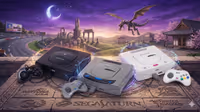
The Misunderstood Brilliance of the Sega Saturn
We explore the towering ambition, the infamously complex dual-CPU architecture, and the legendary, arcade-perfect library.
Nano Banana
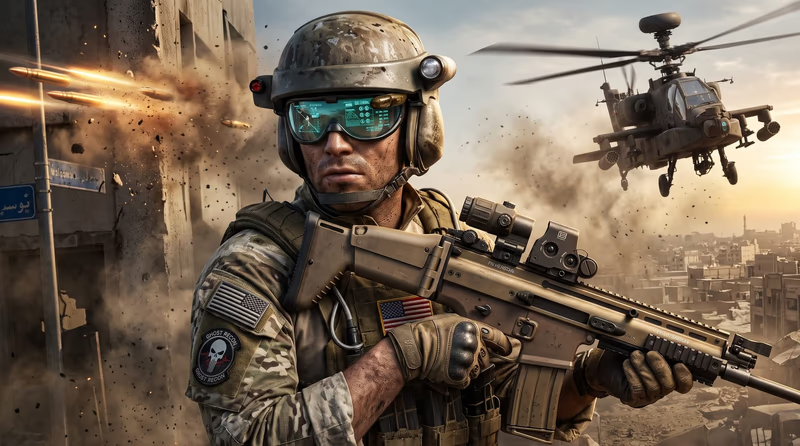
When Tom Clancy’s Ghost Recon Advanced Warfighter (GRAW) launched in early 2006, it served as the defining showcase for the raw power of the seventh console generation. Rather than sticking to the open-country skirmishes of its predecessors, Ubisoft embraced the U.S. Army's real-world "Integrated Warfighter System" program, transforming the franchise into a high-tech, near-future military simulation.
Set in 2013, the campaign follows Captain Scott Mitchell and his elite squad of Ghosts during a deployment to Mexico City. What begins as a VIP security detail for the North American Security Summit quickly collapses into total chaos following a violent military coup d'état.
Cut off behind hostile lines, Mitchell must navigate urban warzones, secure the U.S. President, rescue the Canadian Prime Minister, and neutralize stolen nuclear codes before a full-scale international war erupts.
The centerpiece of GRAW's innovation was the Integrated Cross-Com System, an interface that fundamentally changed how tactical shooters handled squad management:
Unlike the run-and-gun shooters that dominated the era, GRAW was brutally unforgiving:
Mexico City served as a phenomenal playground for modern tactical warfare. Ubisoft meticulously recreated the sprawling scale of the metropolis, from claustrophobic shantytowns and sun-drenched industrial plazas to towering high-rises and iconic landmarks like the Paseo de la Reforma and the Zócalo.
The verticality of the urban design meant threats could emerge from any window, alleyway, or rooftop. Snipers, RPG emplacements, and technical gun trucks forced players to constantly check their six and rely on their squad to cover blind spots.
Beyond its intense campaign, GRAW set the gold standard for early Xbox Live multiplayer:
Visually, GRAW was a technical masterclass in 2006. It showcased cutting-edge HDR lighting, dense volumetric dust clouds, dynamic particle debris, and authentic military uniforms equipped with lifelike web gear.
The audio design heightened the immersion further with deafening gunfire acoustics, echoing explosions through concrete canyons, and authentic radio chatter over the Cross-Com network.
Pros:
Cons:
Tom Clancy’s Ghost Recon Advanced Warfighter is a landmark title that redefined the tactical military shooter. By balancing lethal firefights with the futuristic convenience of the Cross-Com interface, Ubisoft crafted a tense, demanding, and visually stunning urban warfare experience that remains a high point for both the franchise and seventh-generation gaming.

Affiliate link: Support the blog via Instant Gaming at no extra cost.
Tom Clancy's Ghost Recon Advanced Warfighter
Others Posts
We explore the towering ambition, the infamously complex dual-CPU architecture, and the legendary, arcade-perfect library.
A tactical field manual to identifying, engaging, and obliterating the deadliest champions of the Ruinous Powers. Equip your holy arsenal, never stop moving, and prepare to bring the Emperor’s light to the darkest corners of Graia.
A deep dive into Raven Software’s brutal 2005 shooter, a game that traded the demonic scares of Doom 3 for the disturbing, flesh-and-metal horrors of the Strogg assimilation.
A retrospective on Call of Duty 2: Infinity Ward's WWII masterpiece, the revolution of regenerating health, and its impact on the Xbox 360 era.
How Epic Games delivered a devastatingly emotional conclusion, revolutionized cooperative play, and cemented the ultimate legacy of the Xbox 360 generation.
A comprehensive starter strategy to master the physics, optimize your deliveries, and utilize the new Director’s Cut tools to conquer the apocalyptic wasteland of America.
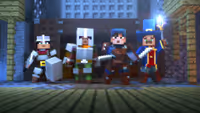
Are the Minecraft Dungeons DLCs worth buying? We break down all 6 expansions, their biomes, unique mechanics, boss fights, and rank the absolute must-haves.
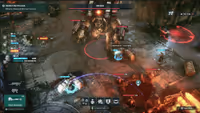
Master turn-based combat in Gears Tactics. Learn to chain executions for infinite Action Points, optimize class builds, and crush colossal bosses.

Analysis of the PlayStation 4 and PS4 Pro hardware. We examine the shared CPU bottleneck, the mirrored butterfly GPU design, memory optimizations, and the hardware-level checkerboard rendering that enabled the 4K transition.

PlayStation 5 Pro hardware: PSSR, Advanced Ray Tracing, and the AI Revolution. We analyze Sony's PlayStation Spectral Super Resolution (PSSR), RDNA 4 Ray Tracing advancements, and the engineering behind the end of the Fidelity vs. Performance compromise.
guides
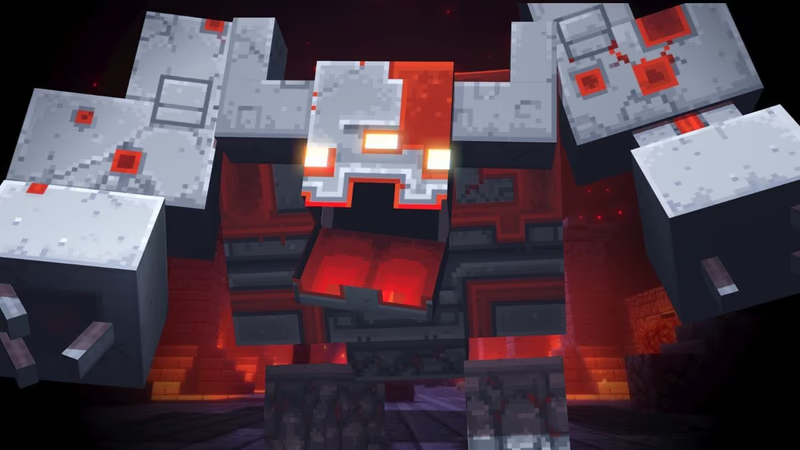
Conquer the toughest bosses in Minecraft Dungeons. Master attack patterns, exploit weak points, and equip the best builds for every major fight.